
Who wrote it
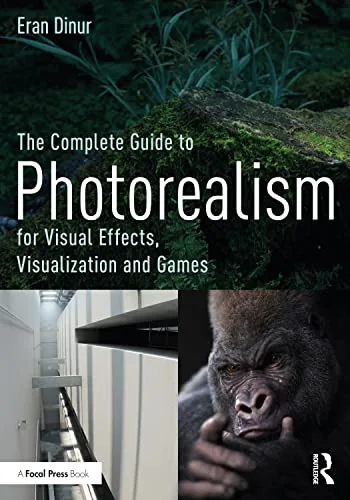
Cover of The Complete Guide to Photorealism for Visual Effects, Visualization and Games, Eran Dinur (Routledge / Focal Press, 2022). Cover © 2022 Taylor & Francis, shown only to identify the book these pages discuss.
Eran Dinur is a visual effects supervisor and CG artist. His credits include The Wolf of Wall Street, The Greatest Showman, Spider-Man: Homecoming and Iron Man 3, and he teaches VFX. He also wrote The Filmmaker's Guide to Visual Effects.
That background matters for how the book reads. It is written by a working supervisor who has had to make photoreal images on deadline, and it consistently prefers a usable mental model over a complete technical one.
The problem the book is trying to solve
Photorealism has become the goal of enormous parts of the digital image industry - visual effects, architectural and product visualization, games - and yet almost nobody teaches it as a subject in its own right. The available material teaches software: how to build a shader in this renderer, how to key in that compositor. What is missing is the layer underneath, which is how light and surfaces actually behave and why an image reads as real.
Dinur's argument is that photorealism is a knowledge problem before it is a software problem.
Tools change constantly; the physics does not. An artist who understands why a shadow is bluer than its surroundings can produce that shadow in any application, including one that has not been written yet. An artist who only knows which slider to move is stuck the moment the studio changes packages.
That is also why the book is deliberately software-agnostic. It names applications for context - Nuke, Maya, Blender, V-Ray, Arnold, Unreal, Substance - but it does not teach any of them.
How these pages are organized
Four parts, and the structure is the argument:
- Core Concepts - what photorealism actually is, how it differs between industries, and color. The conceptual groundwork.
- The Real World - light, its interaction with matter, daylight, artificial light, shadows, materials, and the camera. No computers at all in this part. It is a physics and observation primer.
- The CG World - rendering, shading, texturing and modeling. Reproducing Part 2 inside a 3D application.
- The 2D World - compositing, relighting, shadows and lens effects. Reproducing Part 2 on a flat image.
Parts 3 and 4 both depend entirely on Part 2. That is the point of putting the physics first: the CG and compositing chapters are not separate subjects, they are two different ways of faking the same set of behaviors.
The recurring theme worth watching for
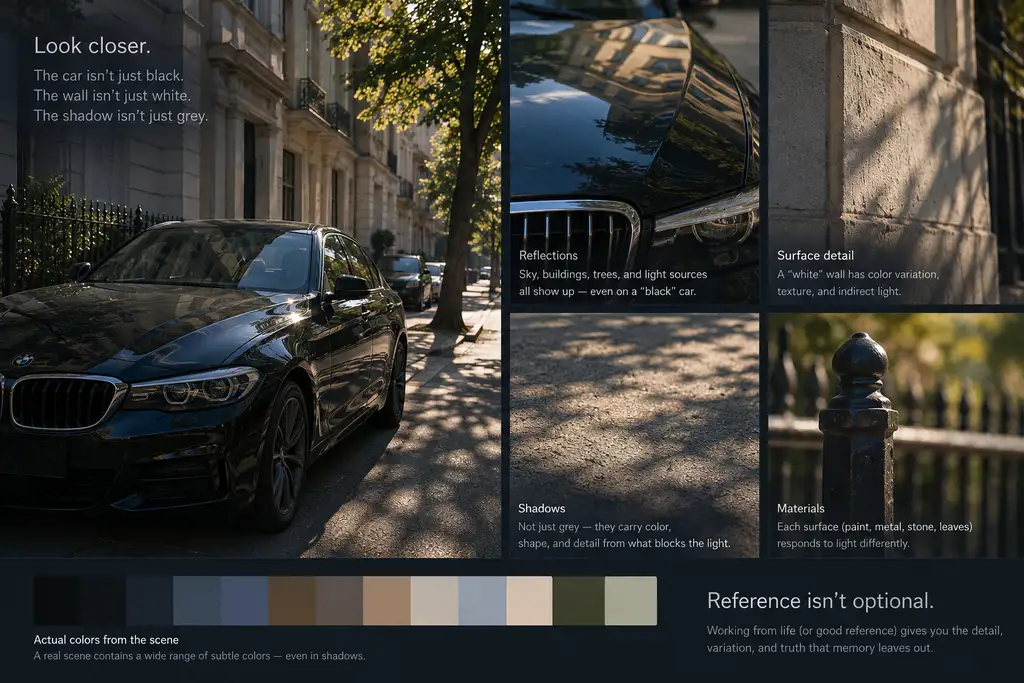
Course image created with generative AI using OpenAI tools, with direction and curation by the course instructor.
Dinur returns to one idea in almost every chapter, and it is the most useful thing in the book: learn to observe. Not to look - to observe. Most people, including most digital artists, walk through the world with an extremely simplified mental picture of it. The car is black. The wall is white. The shadow is gray. None of that survives actually looking.
He treats the ability to break a real scene down into its components - what light is arriving, from where, how much of it is direct, what each surface is doing to it - as the core professional skill. Software gets you the output. Observation tells you what the output should be.
The corollary is that reference is not optional. Working from memory is working from that simplified mental picture, which is why it produces flat, generic images.
How to use this series
There are twelve pages, one per chapter for the Introduction and chapters 1 to 10, plus one condensed page each for Part 3 and Part 4. Each has the same shape: what the chapter argues, the ideas in order, a section on what it means for projection mapping, the terms, and a set of questions to test yourself against.
They are guides, not replacements. The book has several hundred photographs and diagrams doing work that text cannot do, and the case studies are worth reading in full. Use these pages to know what you are looking for before you open it, and to find your way back to something afterwards.
If you read only three chapters, read 3 (Color), 5 (Light Interaction) and 8 (Shadows).
Check yourself
- Why does Dinur argue that photorealism should be taught separately from software?
- Why does Part 2 come before Parts 3 and 4?
- What does he mean by observation, and how is it different from looking?
- What is the projection mapping equivalent of the integration problem in VFX?