The question the chapter opens with
Course image created with generative AI using OpenAI tools, with direction and curation by the course instructor.
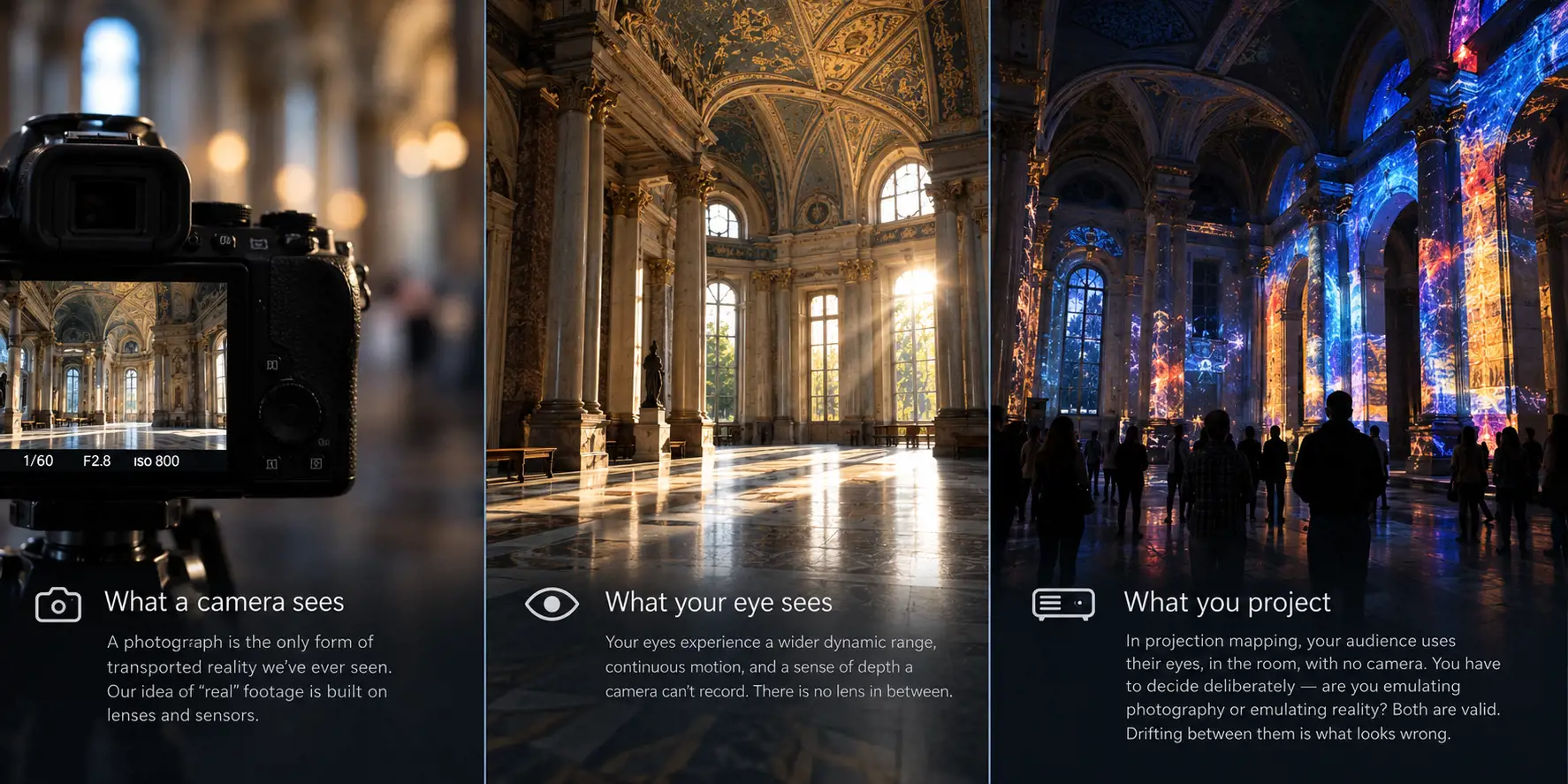
Dinur starts with the definition everyone reaches for first: if it looks like a photo, it is photoreal. Then he asks the obvious follow-up. Why "looks like a photo"? Why not "looks real"?
His answer is that we have no way to record what a person sees. Everything that reaches us on a screen has already passed through a camera. A photograph is the only form of transported reality any of us has ever seen. So our sense of what real footage looks like is not built on our own eyes at all - it is built on a century and a half of lenses and sensors.
That is why photorealism means emulating photography rather than emulating vision. If you build an image the way your eye actually works, it reads as wrong.
Eye and camera: what matches, what does not
The parts line up more or less one to one. The cornea and lens do the job of the camera's glass. The iris is the diaphragm, opening and closing to control how much light gets in. The retina takes the place of the sensor, reading frequency and intensity and passing it down the optic nerve.
The differences are where the chapter earns its keep.
Course image created with generative AI using OpenAI tools, with direction and curation by the course instructor.
Field of view
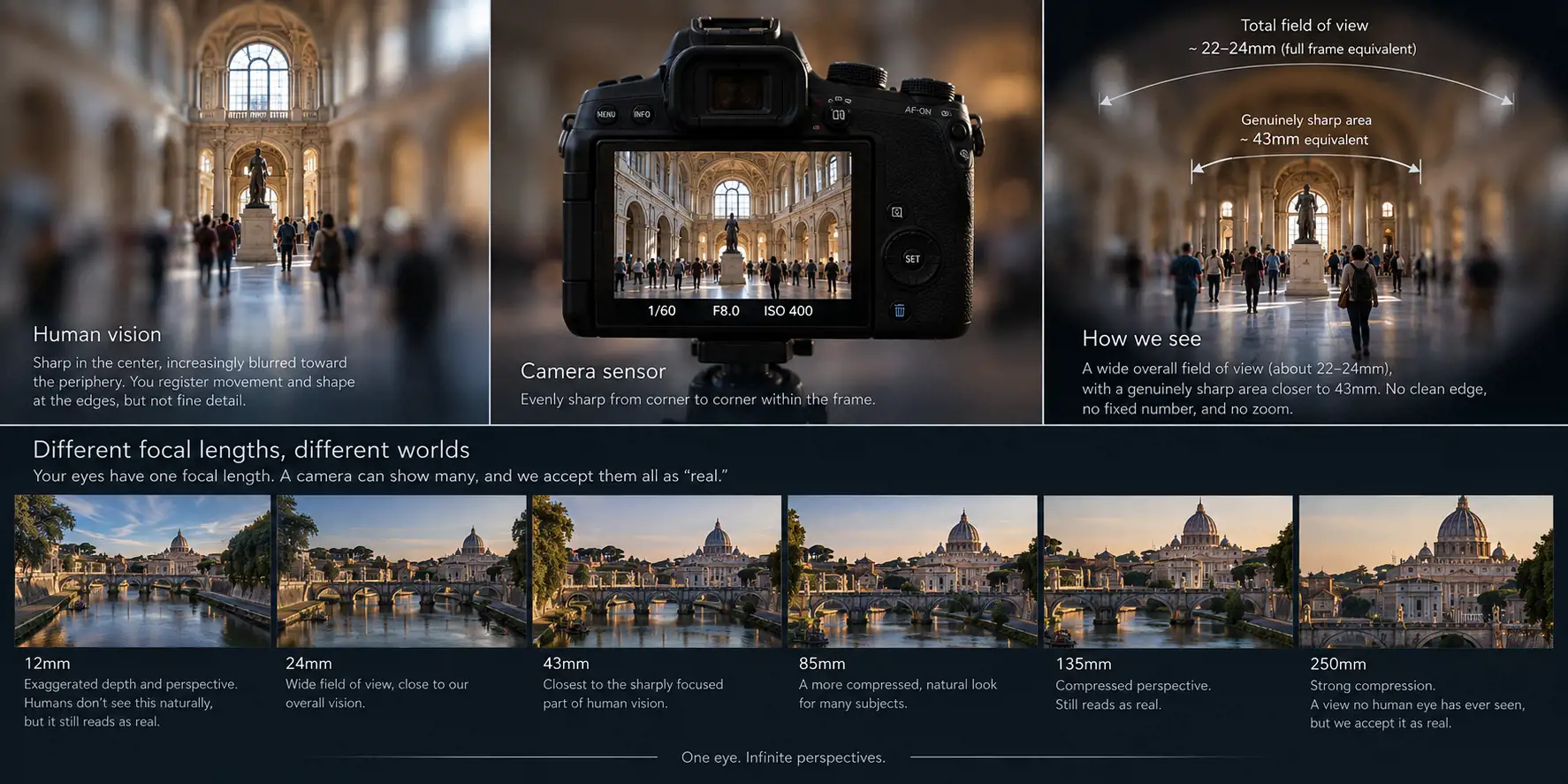
A sensor is evenly sharp corner to corner, and a lens has a focal length you can state as a number. Your vision does not. Sharpness falls off hard from the center outward. Wave your hand beside your ear and you will register it, but you cannot read it. There is no clean edge to your field of view, so there is no honest number for it.
The working figures Dinur gives: our overall field is roughly a 22-24mm lens on a full-frame camera, and the genuinely sharp part is closer to 43mm. That is why medium lenses have always been the ones used to stand in for a human point of view.
The part that matters more
You cannot change your focal length. You have one prime lens, permanently fitted, and no zoom. The entire perspective vocabulary of photography - the stretched depth of a wide lens, the flattening of a long one - is something no human being has ever seen with their own eyes.
And we accept all of it without complaint. A 12mm shot and a 250mm shot both read as real. Meanwhile the techniques that genuinely mimic human vision, like tilt-shift, read as artificial and strange. That is how completely the language of the lens has replaced the evidence of our own eyes.
Seeing with the mind
Course image created with generative AI using OpenAI tools, with direction and curation by the course instructor.
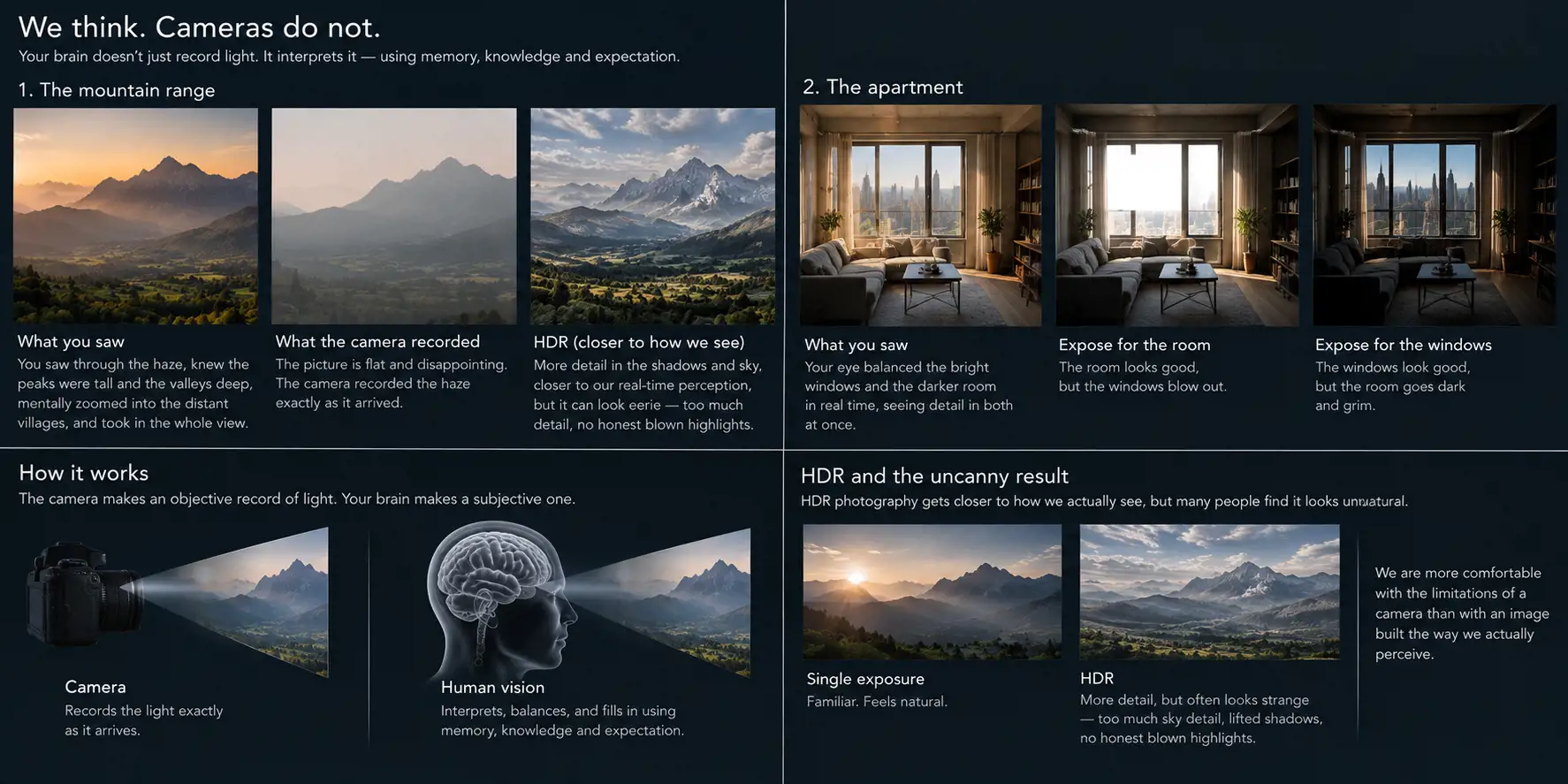
We think. Cameras do not. Dinur illustrates it with two situations you have both been in.
- You photograph a mountain range and the picture is flat and disappointing. Standing there, you saw through the haze, you knew the peaks were tall and the valleys deep, and you were mentally zooming into the distant villages while taking in the whole view. The camera recorded the haze exactly as it arrived.
- You photograph an apartment. Expose for the room and the windows blow out. Expose for the windows and the room goes dark and grim. Your eye was balancing both in real time, continuously, without being asked.
The camera makes an objective record of light. Your brain makes a subjective one, augmented on the spot by memory, knowledge and expectation, and you cannot separate the two processes because they happen at once.
The interesting consequence: attempts to photograph the way we see have not caught on. HDR photography gets close to our real-time exposure balancing, and it looks eerie - too much sky detail, lifted shadows, no honest blown highlights. We are more comfortable with the single-exposure limits of a camera than with an image built the way we actually perceive.
The uncanny valley, widened
Course image created with generative AI using OpenAI tools, with direction and curation by the course instructor.
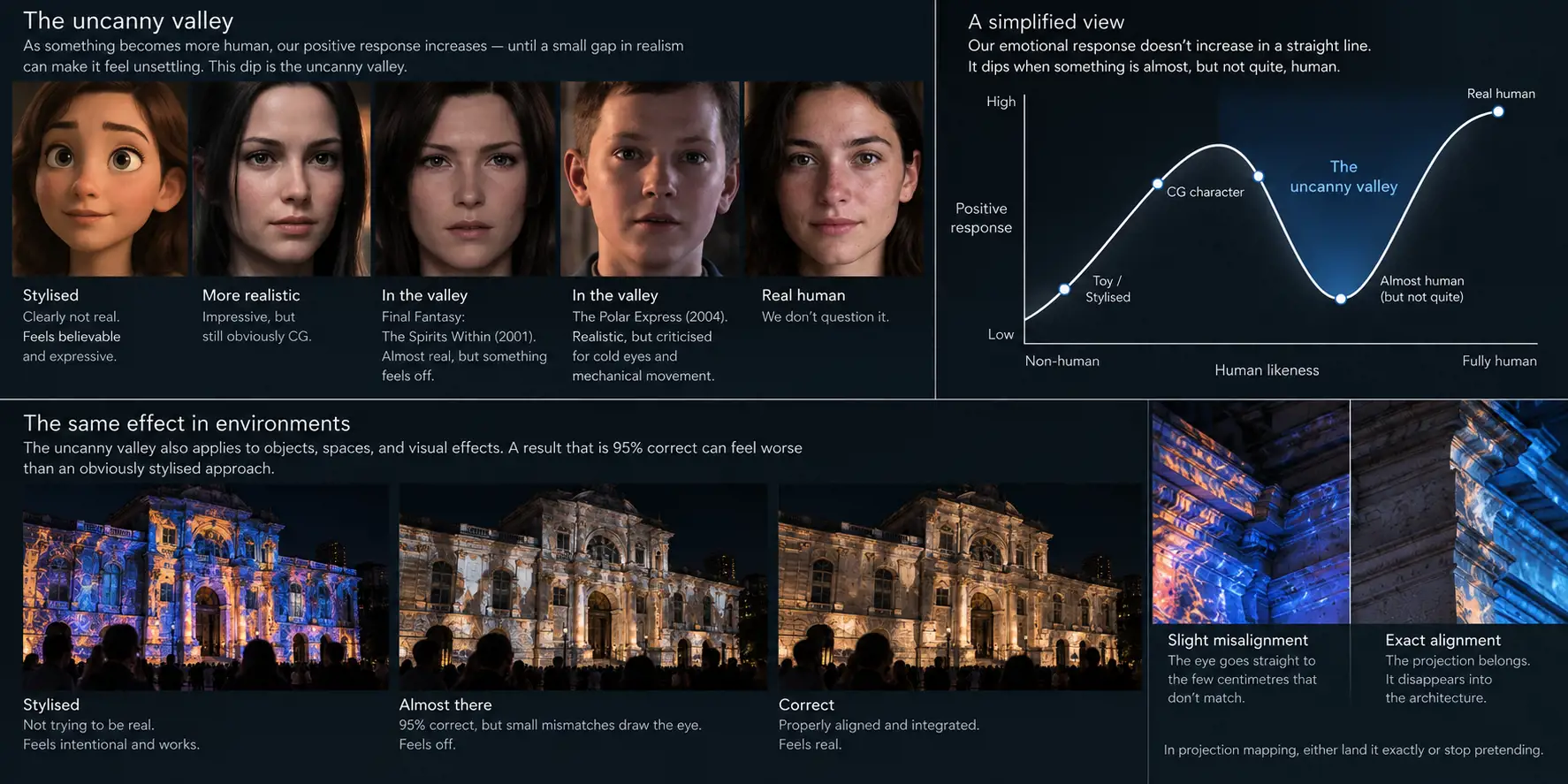
The term came out of 1970s robotics and got borrowed for CG characters: the dip in how we respond to something that is almost human but not quite. Final Fantasy: The Spirits Within and The Polar Express are the standard examples, criticised for coldness in the eyes and a mechanical quality of movement precisely because they were more realistic than anything before them.
Dinur's argument is that the same effect operates on environments and objects, just more mildly. It is the visual effect that is impressive and still feels off. The architectural render that is technically flawless and somehow sterile. Something is wrong and you cannot name it.
He notes that successful stylised animation avoids the problem by staying well clear of the valley on purpose. Anything reaching for photorealism is committed to crossing it.
The detail conundrum
In the real world every element keeps existing whether the camera can resolve it or not. In CG you build only what is needed. Dinur calls the threshold the bare necessity line: the amount of detail required at a given distance from the subject.
In visual effects you know the camera move in advance, so the line is easy to draw. In games the camera is the player's, so everything must hold up from anywhere - which is what dynamic level of detail (LOD) exists to manage, swapping between versions of an asset by distance.
But he argues that framing and LOD are only a partial fix, because the real problem is not producing the right detail for a given camera. It is accounting for the detail you left out. From a hundred feet you cannot see the detail on any single brick in a wall. The accumulated effect of all those tiny features you cannot individually resolve is still what gives the wall its richness. Strip them out and the wall goes dead in a way that is hard to point at.
The role of imperfections
Course image created with generative AI using OpenAI tools, with direction and curation by the course instructor.
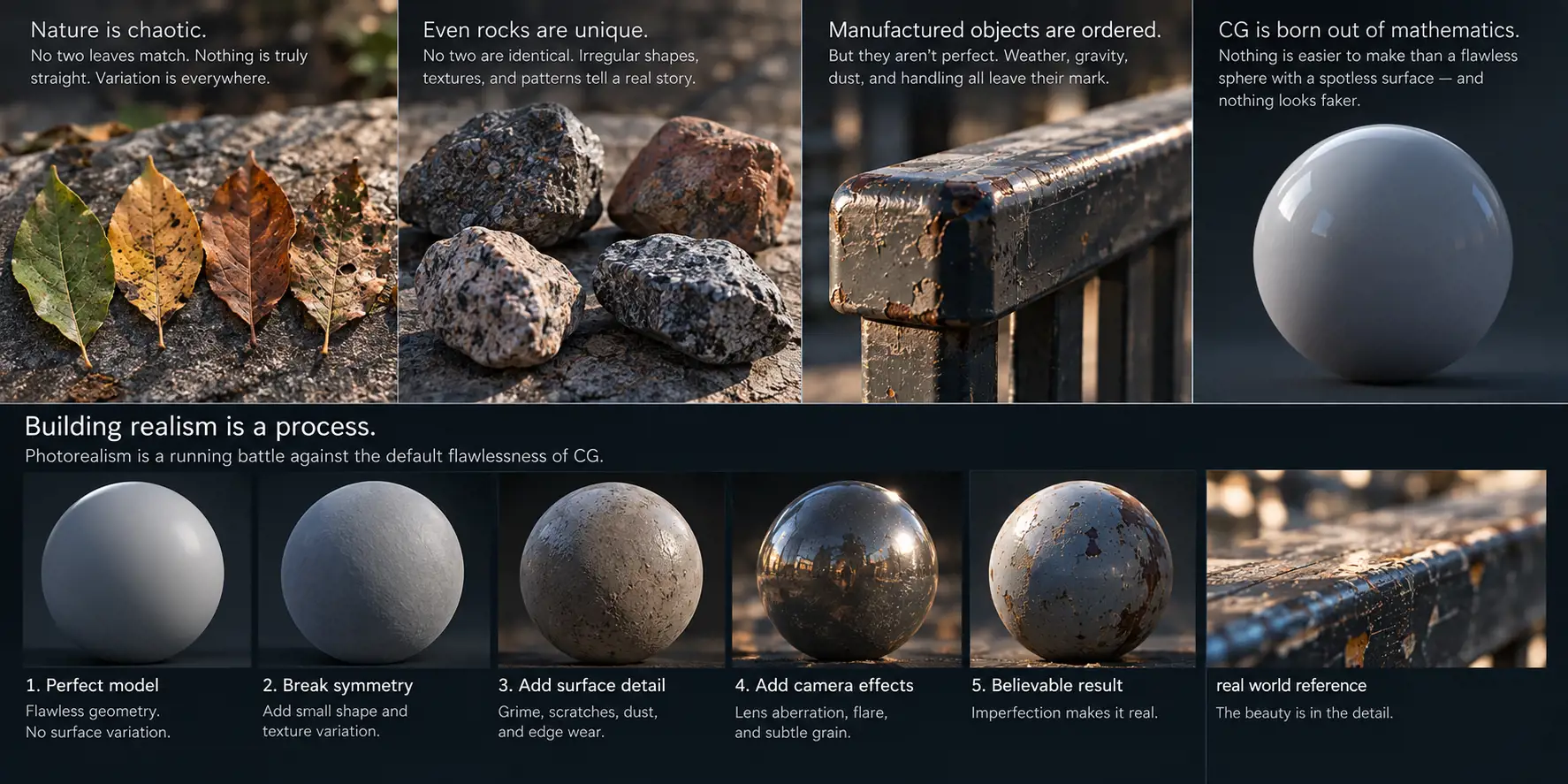
Nature is chaotic. No two leaves match, no two rocks are identical, nothing is truly straight. Manufactured objects are far more ordered, but even they are not perfect - weather, gravity, dust and handling let some of that chaos back in.
Computer graphics is born out of mathematics and is inherently perfect. Nothing is easier to make than a flawless sphere with a spotless surface, and nothing looks faker. Dinur frames photorealism as a running battle against the default flawlessness of CG, fought at every stage: breaking symmetry in the model, adding grime to the texture, and putting aberration, flare and grain back in at the end.
The reality of the unreal
If a scene depicts something nobody has ever seen - an alien planet, a floating mountain - what work is photorealism doing?
His answer: the convincing ones do not break every rule at once. Avatar's floating mountains are impossible, but the vegetation, rock, cloud, light and atmospheric depth on them are all completely familiar. The unreal element is carried by everything around it that behaves normally. Same with the folding streets in Inception and the motionless ships in Arrival.
Quality is not realism
Course image created with generative AI using OpenAI tools, with direction and curation by the course instructor.
This is the part Dinur says students find hardest, and it is worth sitting with.
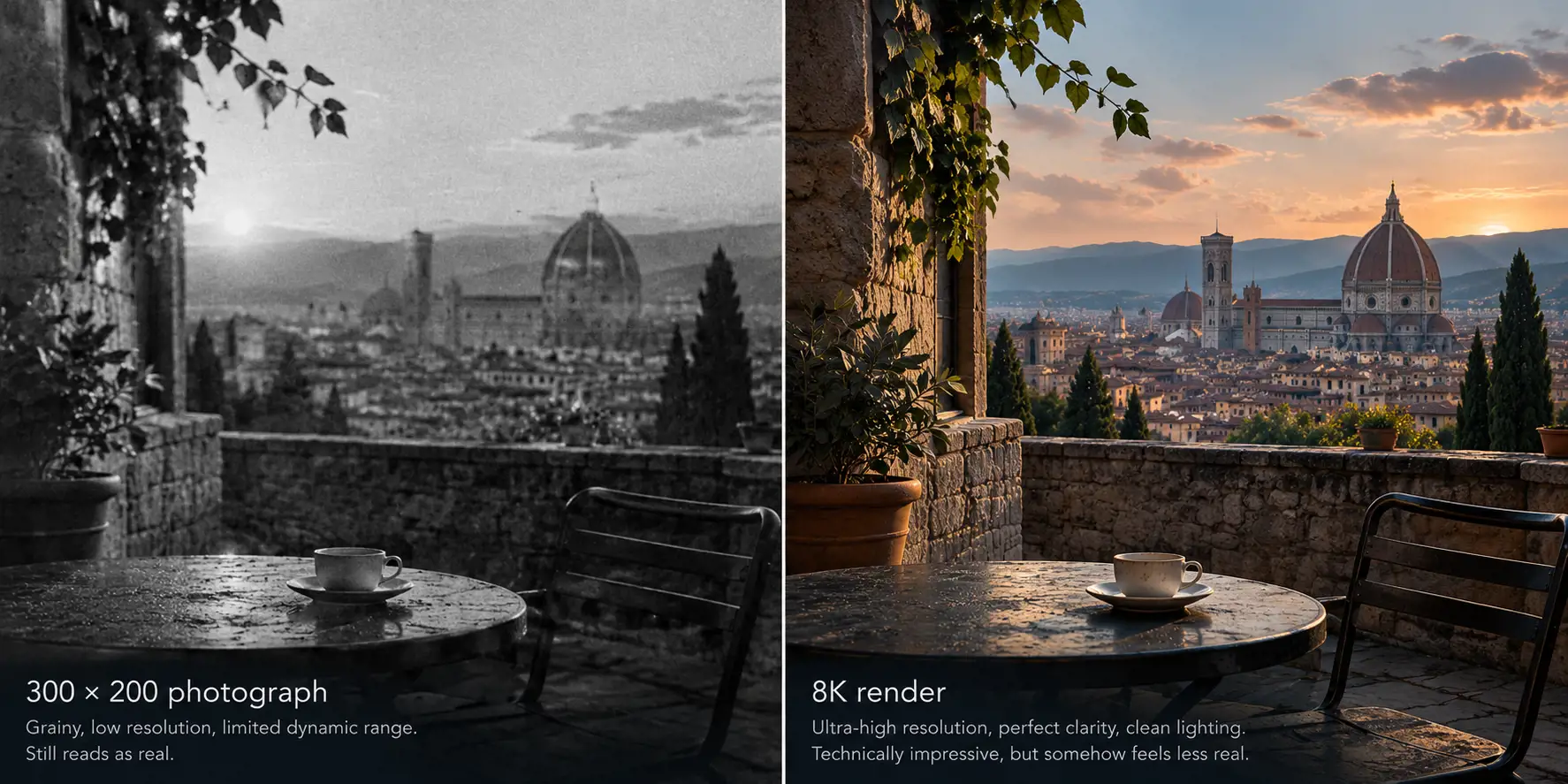
A grainy black and white 300x200 photograph can be more photoreal than a shiny 8K render. Resolution, bit depth and dynamic range matter enormously for capturing and manipulating an image, but they do not by themselves make it read as real. What does that work is the interaction of light and surface, the richness of texture, the sense of depth, and the behavior of the lens. If the image is convincing, it stays convincing at the lowest quality setting you can display it at.
Terms from this chapter
- Photorealism - looking like a photograph, which is not the same as looking like what your eye sees.
- Uncanny valley - the dip in response to something almost, but not quite, convincing.
- Bare necessity line - the level of detail actually required at a given viewing distance.
- Dynamic level of detail (LOD) - swapping between versions of an asset based on distance from camera.
- HDR photography - merging multiple exposures into one image. Distinct from HDR as a CG lighting tool, which comes back in Chapter 11.
Check yourself
- Why does photorealism mean emulating a camera rather than emulating your own vision?
- Name two things a camera does that your eye cannot, and one thing your eye does that a camera cannot.
- What is the bare necessity line, and why is framing for it only a partial solution?
- Why does a perfectly clean CG surface read as fake?
- Why can a low-resolution image be more photoreal than a high-resolution one?
- In your own project, what is the equivalent of the live-action plate you have to integrate with?