
What this is
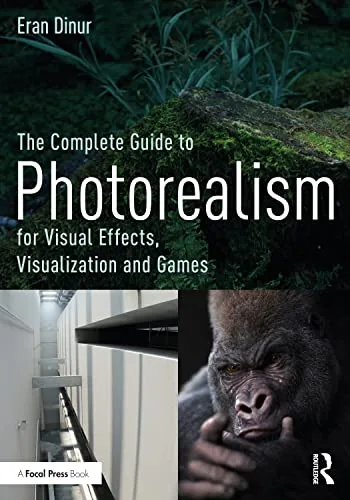
Cover of The Complete Guide to Photorealism for Visual Effects, Visualization and Games, Eran Dinur (Routledge / Focal Press, 2022). Cover © 2022 Taylor & Francis, shown only to identify the book these pages discuss.
Eran Dinur's The Complete Guide to Photorealism for Visual Effects, Visualization and Games (Focal Press, 2022) is the best single account of how light behaves and why an image reads as real. It is not a projection mapping book, and that is fine - the physics half of it describes your medium more directly than it describes anything on a screen.
These pages are a reading guide, one per chapter. Each one covers what the chapter argues, the ideas in order, and the terms you need.
They are guides, not replacements. The book carries several hundred photographs and diagrams doing work that text cannot do. Use these pages to know what you are looking for before you open it, and to find your way back to something afterwards.
If you only read three
Read Chapter 3 (Color), Chapter 5 (Light Interaction) and Chapter 8 (Shadows).
Color, because your projector is an additive device and that chapter is a description of your instrument. Light interaction, because it is the specification for whatever surface you are projecting onto. Shadows, because contact shadows are the cheapest fix in the whole book and the one students skip most.
Part 1: Core Concepts
- 00: Introduction - who wrote it, why photorealism is a knowledge problem before it is a software problem, and how to read the book.
- 01: Reality and Photorealism - why photorealism means emulating a camera rather than your own eye. The uncanny valley, the bare necessity line, and why quality is not realism.
- 02: Photorealism in Digital Media - VFX, games and visualization. Three industries, three different definitions of "real enough", and which constraints apply to you.
- 03: Color - the six-layer model, additive versus subtractive, hue and saturation and brightness in RGB terms, the five color operations, bit depth, and the low end.
Part 2: The Real World
No computers at all in this part. It is a physics and observation primer, and it is the foundation everything else rests on.
- 04: Light Essentials - waves and particles, the inverse-square law, direct and indirect illumination, and why "ambient light" does not exist.
- 05: Light Interaction - absorption, reflection and transmission. Specular versus diffuse, rim highlights, subsurface scattering, refraction, albedo.
- 06: Daylight - one light source and the atmosphere that makes it interesting. Rayleigh and Mie scattering, volumetric light, aerial perspective.
- 07: Nighttime and Artificial Lighting - the Purkinje effect, color temperature, lumens and lux, and why the fixture matters more than the bulb.
- 08: Shadows - shadows as the relative lack of light. Umbra and penumbra, the four softness factors, shadow color, nested and contact shadows.
- 09: Basic Material Properties - dielectrics and metals, and the Fresnel effect that predicts your worst viewing angle.
- 10: Lens and Camera Characteristics - depth of field and bokeh, distortion, chromatic aberration, flares, bloom, motion blur and grain. The defects that make an image look real.
Part 3: The CG World
- 11-14: The CG World - rendering and lighting, shading, texturing and modeling, condensed into one page. Read the full chapters if you work in Blender, Cinema 4D, Maya or Unreal; the page is enough if you work in After Effects and TouchDesigner. The four ideas that transfer to a wall are the bevel argument, baked-in lighting when you shoot textures, why emission is not a brightness control, and the PBR safe range.
Part 4: The 2D World
- 15-18: The 2D World - integrating 2D elements, integrating CG elements, lighting in 2D, and lens and camera effects, condensed into one page. This is the most transferable part of the book for anyone working in After Effects: edge handling, how to build a shadow that reads as an absence of light rather than a gray smear, faking reflections with the Fresnel effect, and atmospheric depth that lifts the blacks without touching the highlights.
Epilogue
- 19: The Future - written in 2021, read now, which is what makes it worth reading. Real-time rendering, LED virtual sets, machine learning, and a closing argument about whether photorealism will disappear that is worth arguing with in class.
Source
Eran Dinur, The Complete Guide to Photorealism for Visual Effects, Visualization and Games. Focal Press / Routledge, 2022. ISBN 978-0-367-19926-5. These pages summarize and respond to that book; they do not reproduce it.