
Reading: Eran Dinur, The Complete Guide to Photorealism for Visual Effects, Visualization and Games (Focal Press, 2022), Chapter 5, pages 57-67. This page is a guide to that chapter, not a substitute for it.
Three outcomes, and that is all
Course image created with generative AI using OpenAI tools, with direction and curation by the course instructor.
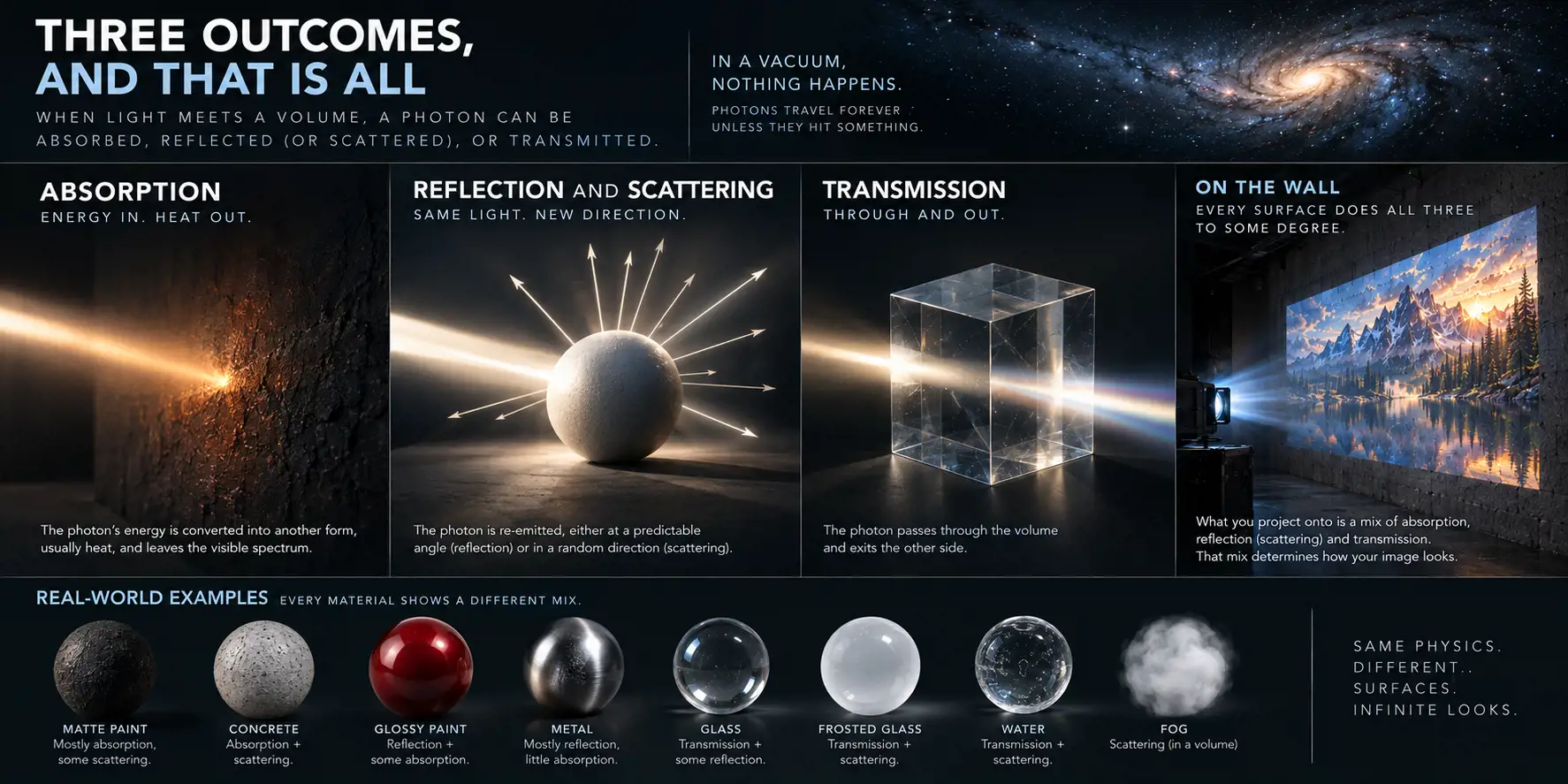
In a vacuum nothing happens to light. Photons hold speed, direction and energy, potentially forever - which is how we see galaxies millions of light years away. The interesting part begins when a photon meets an obstacle, which Dinur calls a volume: anything from a single molecule in a thin gas to a wall of packed electrons in a metal. Solids, liquids and gases all count.
When a photon interacts with the molecules in a volume there are exactly three possible outcomes:
- Absorption - the photon's energy is converted into another form, usually heat, and leaves the visible spectrum.
- Reflection and scattering - the photon is re-emitted, either at a predictable angle or in a random direction.
- Transmission - the photon passes through the volume and exits the other side.
Everything in Part 2 of the book - the color of the sky, the look of a material, fog, lens flares - is built out of those three events. This is the load-bearing chapter.
Absorption
Course image created with generative AI using OpenAI tools, with direction and curation by the course instructor.
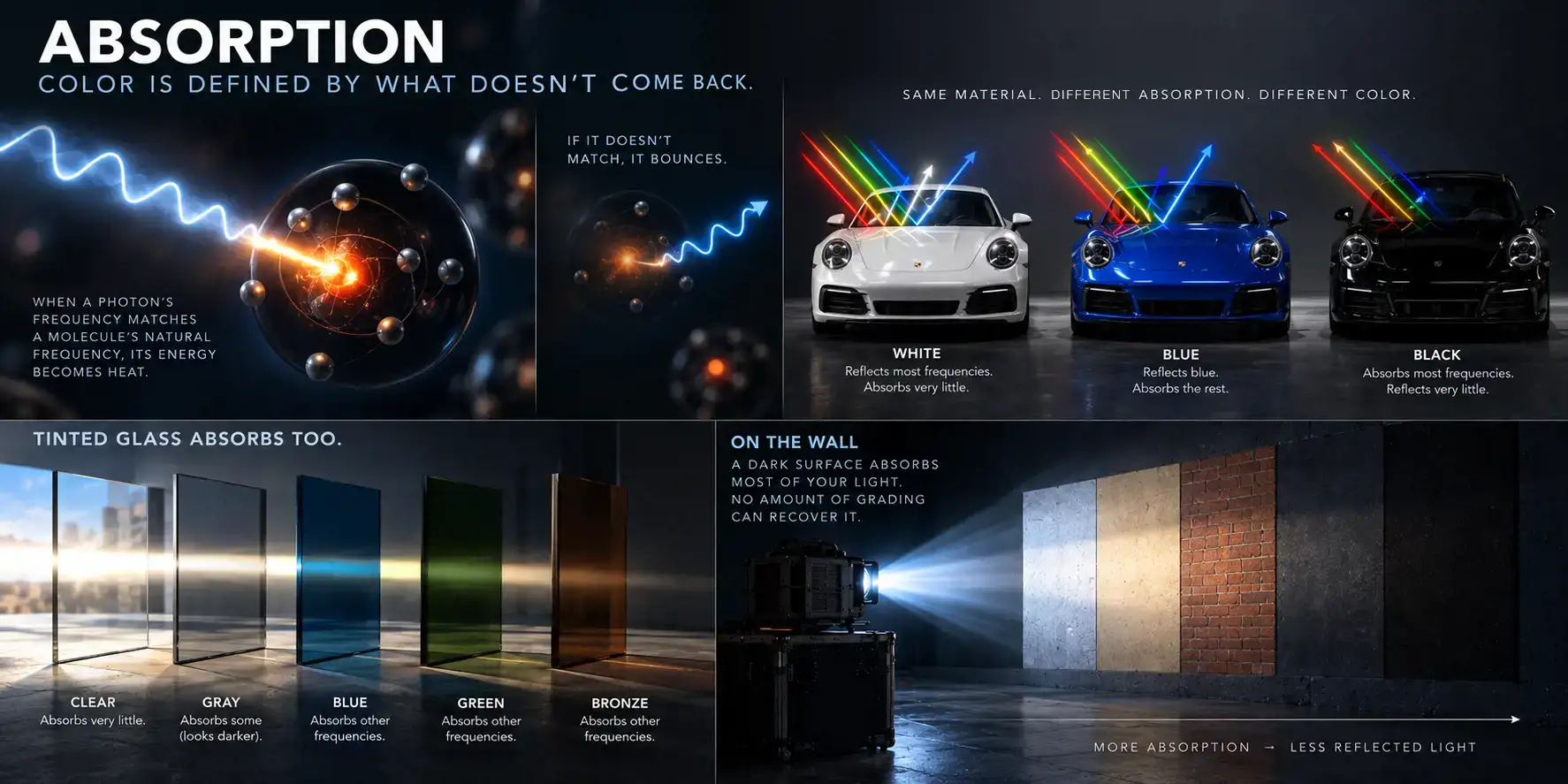
Absorption has nothing to do with how soft, thick or spongy something is. It happens at the molecular level. A surface can absorb strongly and still be harder than steel or thinner than paper. Car paints make the point: white, blue and black paint have identical material consistency, and their color is decided entirely by which frequencies they absorb.
The word is slightly misleading, since photons are not swallowed. Dinur's simplified model: picture electrons attached to the nucleus by springs, vibrating at a natural frequency specific to each type of atom. A photon also carries a frequency. If the two match, the electrons vibrate in resonance, that excitation passes from atom to atom, and the photon's energy becomes heat. If they do not match, a brief excitation re-emits the photon - it is reflected or scattered.
So color is defined by negation. The color you see is the incident light minus whatever was absorbed. And absorption affects intensity as well as hue: black surfaces are much darker than white ones because most of the energy is absorbed and very little comes back. Tinted glass works the same way in transmission - some light is absorbed, so what passes through is darker.
Reflection: why it matters more than anything else
Course image created with generative AI using OpenAI tools, with direction and curation by the course instructor.
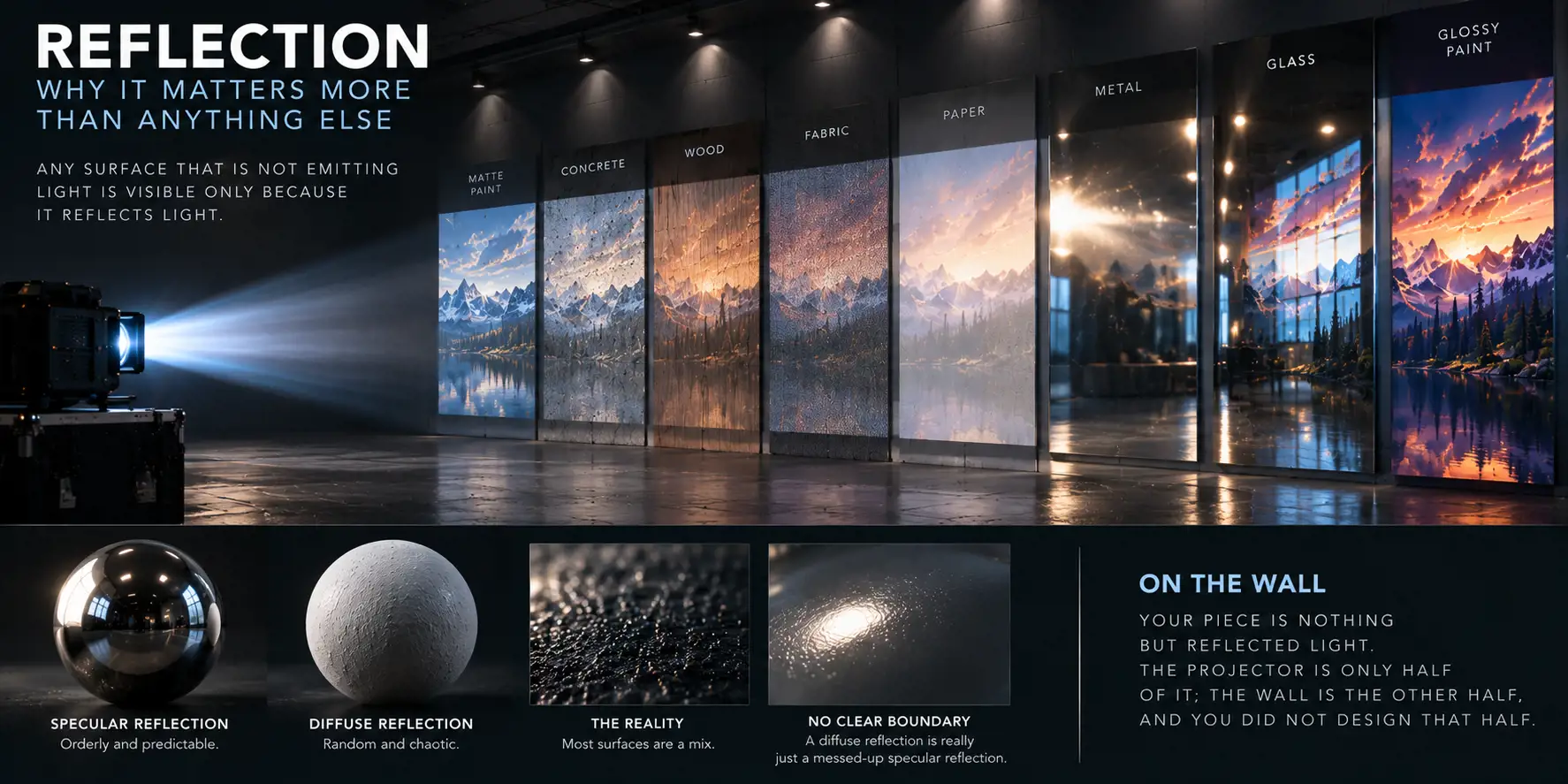
Any surface that is not emitting light is visible only because it is reflecting light. Every photograph, every frame of film and every CG render is first and foremost a record of reflected light. Dinur says flatly that reflection is the most important of the three interactions.
He then clears up a vocabulary problem. In ordinary speech "reflection" means the mirror-like appearance of the environment on something shiny - a lake, a window, a chrome ball. But wood, rubber, fabric and paper reflect light too. The real distinction is whether photons come off at a unified, predictable angle or scatter in random directions.
- Specular reflection - orderly and predictable.
- Diffuse reflection - random and chaotic.
CG workflows separate them cleanly - diffuse controls surface color, specular controls shininess - but reality does not. There is no precise boundary. As Dinur puts it, a diffuse reflection is really just a messed-up specular reflection.
Specular reflection
Course image created with generative AI using OpenAI tools, with direction and curation by the course instructor.
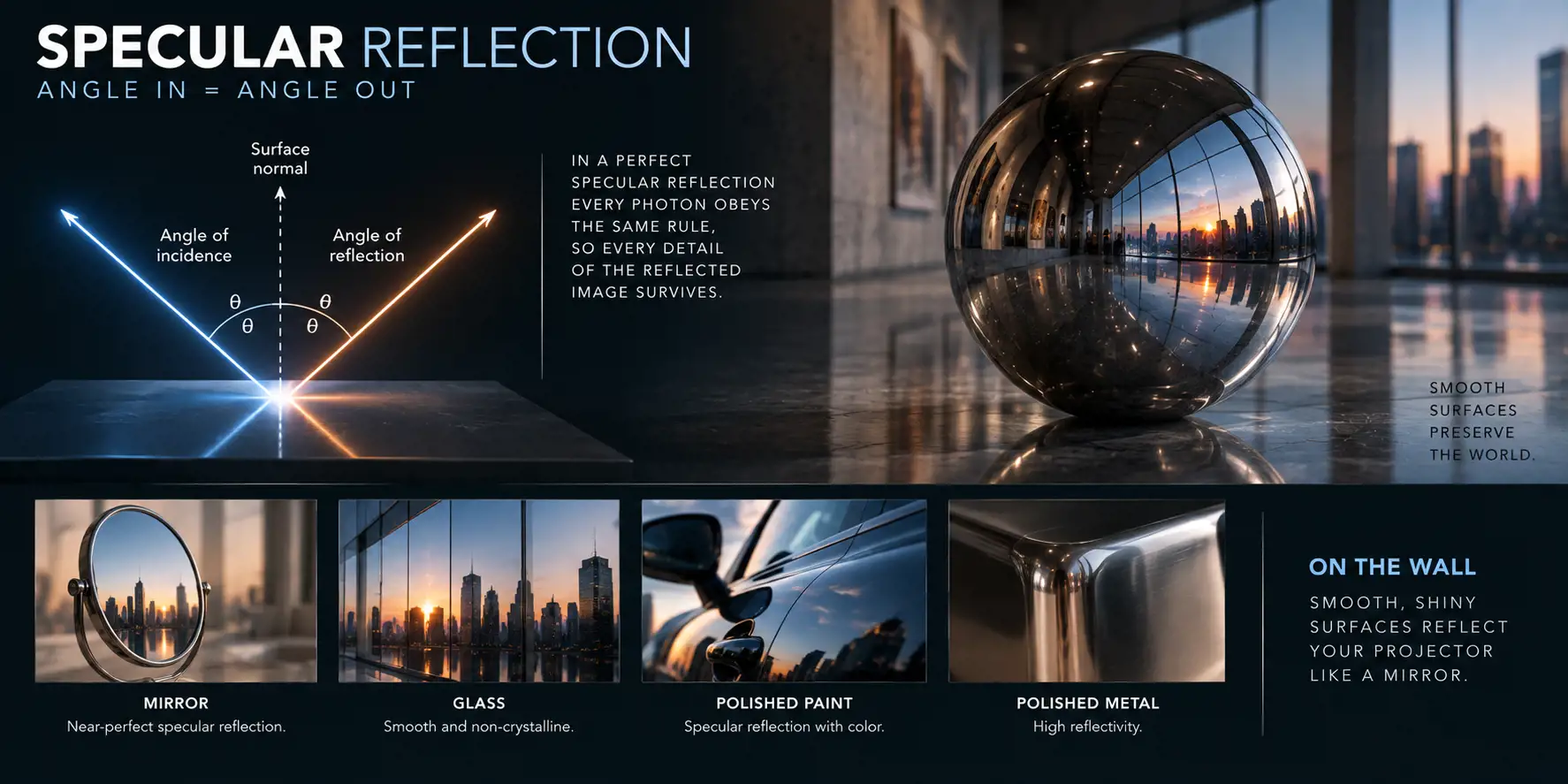
The law of reflection: the angle of reflection equals the angle of incidence, mirrored about the surface normal - the line representing the facing direction of the surface. A squash player predicts the ball's bounce for the same reason.
In a perfect specular reflection every photon obeys that rule, so every detail of the reflected image survives - no blurring, no displacement, no degradation. Mirrors are manufactured to get as close to this as possible: consistently smooth even at microscopic scale, with any irregularity smaller than the wavelength of the incident light. Glass suits the job because it is non-crystalline and has no grain boundaries; a metal coating boosts reflectivity.
Curvature
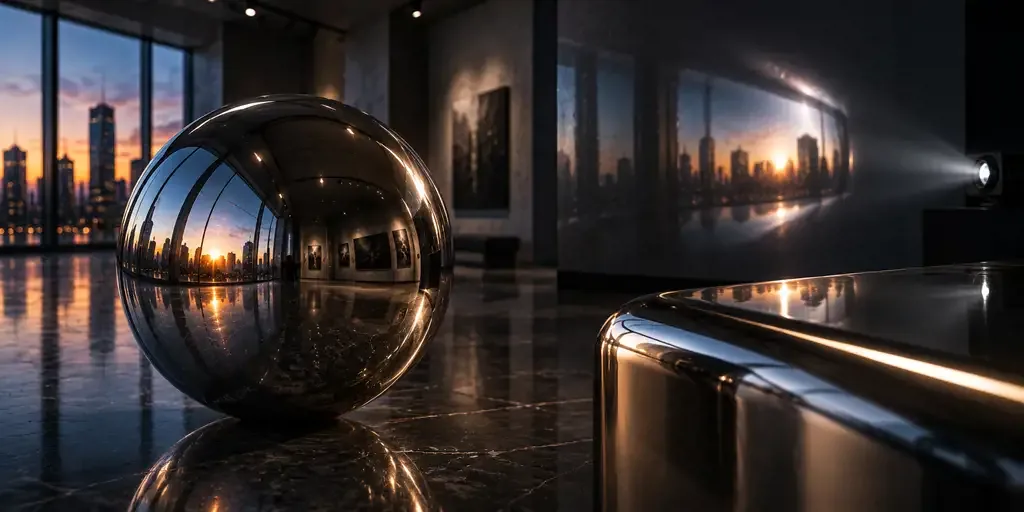
A curved mirror is still fully specular but the image is distorted - not because photons scatter, but because the normals change direction along the curve, so the reflected angle changes with them.
Most surfaces are not perfect mirrors. Imperfect specular reflections blur the reflected image, and when they blur, the brightest areas are the last to remain distinct. Since light sources are dramatically brighter than their surroundings, their appearance in a soft specular reflection dominates it. That dominance is what we call highlights.
To catch a highlight on a flat surface you have to aim that surface at the light. A curved surface changes the odds completely. A chrome ball behaves like a fish-eye lens, covering a much wider angle and reflecting far more of the environment. Photograph a reflective cube on a sunny day and you must rotate it carefully to catch the sun; a sphere has roughly a 50% chance, since the sun only has to be somewhere in the hemisphere behind the camera.
This is why specular reflections are so much more noticeable on curved objects, and it explains rim highlights: bright, distinct reflections along bevels, contours and surface bumps, each curvature acting as a tiny fish-eye lens catching a light source, a window or the sky within a very narrow band. Rim highlights do a lot of the work of describing an object's contours and curvature.
Diffuse reflection
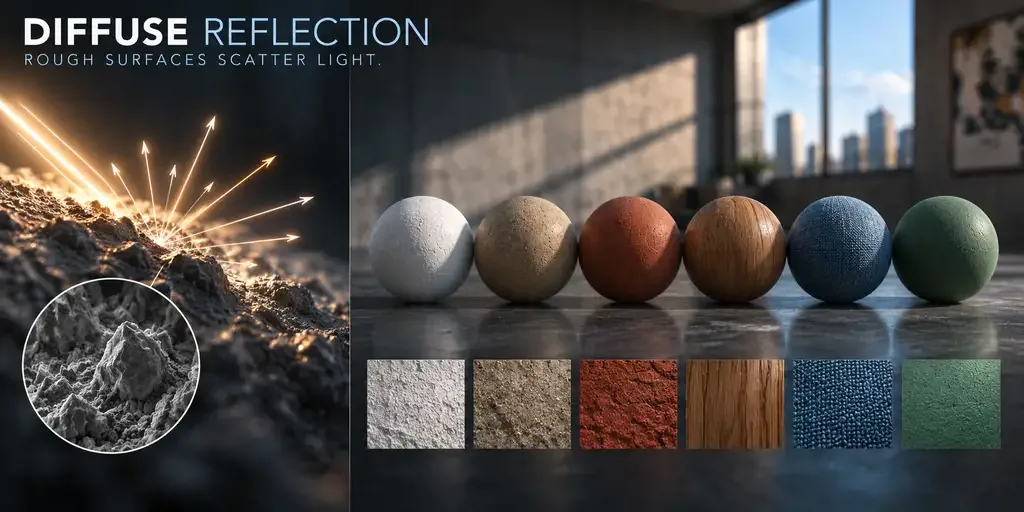
Specular materials are smooth at the scale of light wavelengths. Diffuse materials are not. Dinur extends the squash metaphor: now you are playing against a rocky cliff full of outcrops and cavities, and the bounce is unpredictable.
Most materials are built from microscopic pieces called grain - crystals in rock and ceramics, fibres in wood, paper and fabric. The irregularity of that grain and its boundaries scatters photons in arbitrary directions. Light still reflects, but the detail of the reflected image is destroyed.
A perfectly diffused reflection therefore reads as a uniform color rather than an image of the environment - an average of light intensities, like an extremely heavy blur applied to a photo. That color is whatever was not absorbed, which is why the balance between absorption and diffuse reflection gives a surface its color, and why CG calls it diffuse color.
Scattering and subsurface scattering
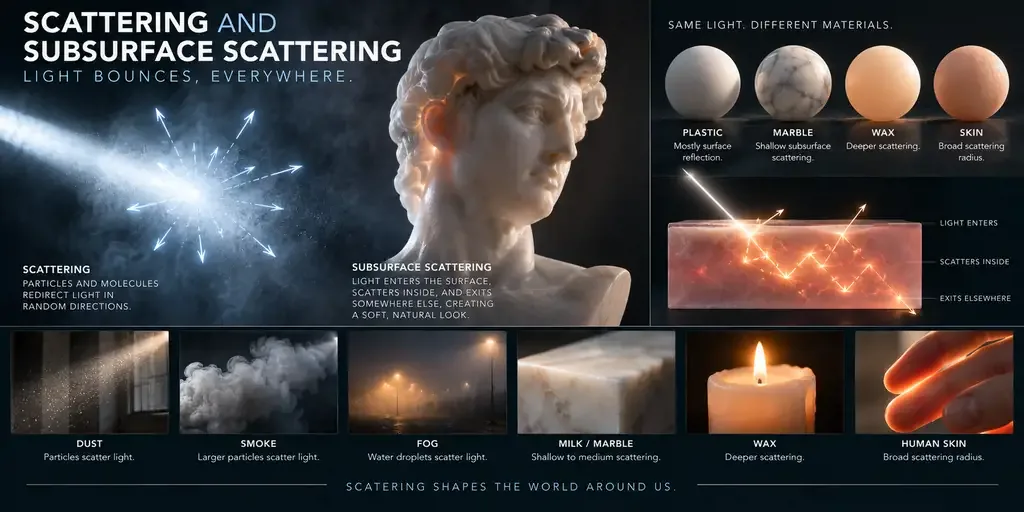
Diffuse reflection is itself a form of scattering, which in physics covers a much wider range of interactions between particles, atoms and molecules. In visual terms scattering usually describes light being diffusely reflected by particles or gas molecules - dust, smoke, water droplets. Rayleigh and Mie scattering, which build the appearance of the sky, come in Chapter 6.
Subsurface scattering is the cliff metaphor again, with the ball entering a cavity, bouncing around inside and leaving from somewhere else. In most non-metallic materials, diffuse reflection involves some penetration below the surface. That internal scattering and the small displacement of the exit point produce the characteristic soft feel of many diffuse surfaces.
Deeper penetration produces a milky look as surface features blur - marble is the example. Deeper still, with a larger scattering radius, and the material reads as almost translucent, as with wax or human skin, even though light is not really being transmitted through it.
The important correction: subsurface scattering is a CG term, usually a separate shader parameter. That is a practical convenience, not a description of reality. It is not a separate process from diffuse reflection, and it is not exclusive to a few special materials - it is an integral part of the diffuse character of almost all dielectric, which is to say non-metallic, materials.
Transmission and refraction
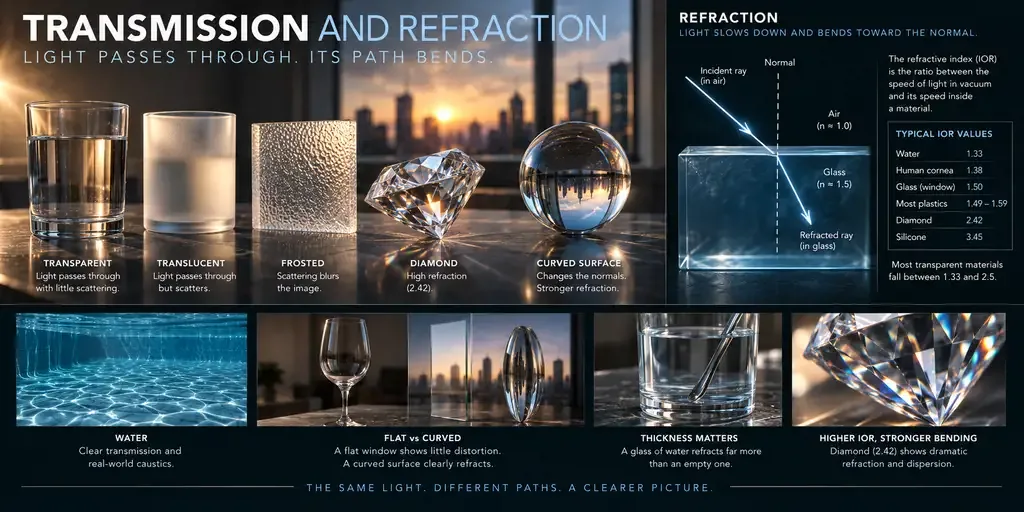
When light is neither fully absorbed nor fully reflected, it passes through and exits the far side. We read a surface as transparent when light from behind it reaches our eyes through it.
Clear transmission needs a uniform microscopic structure with little or no grain to scatter the light. Pure water qualifies. So does glass, which is not a typical solid at all - it is often described as a super-cooled liquid. Where the structure is less uniform the transmitted light scatters and the image blurs, and we call the material translucent. The relationship is the same as the one between specular and diffuse: translucency is messed-up transparency, transmitting and scattering at once.
Refraction
Transmission slows photons down, and the sudden change of speed at the boundary makes the path veer. In air the slowdown is tiny. In glass light travels about 1.5 times slower; in diamond about 2.5 times.
Refraction bends light toward the direction of the normal, so when the normal is at a straight angle there is little or no bending. That is why looking through a flat window shows no visible distortion while a curved surface clearly does. Thickness and the number of different mediums in the path matter too - a glass of water refracts far more strongly than an empty one.
The refractive index (index of refraction, or IOR) is the ratio between the speed of light in vacuum and its speed inside the volume. Higher ratio, stronger deviation, more distortion. Water is 1.33; most liquids fall between 1.33 and 1.5; the human cornea is about 1.38; window glass is 1.5 and most transparent plastics hover near it. Diamond is 2.42 and silicone 3.45, but most transparent materials sit in the narrow band of 1.33 to 2.5.
Dinur is relaxed about accuracy here - we are not very sensitive to it, and few people would spot a wine glass rendered at IOR 2.5. But IOR also drives the Fresnel effect in physically based rendering, so getting it right is still worth doing.
Albedo
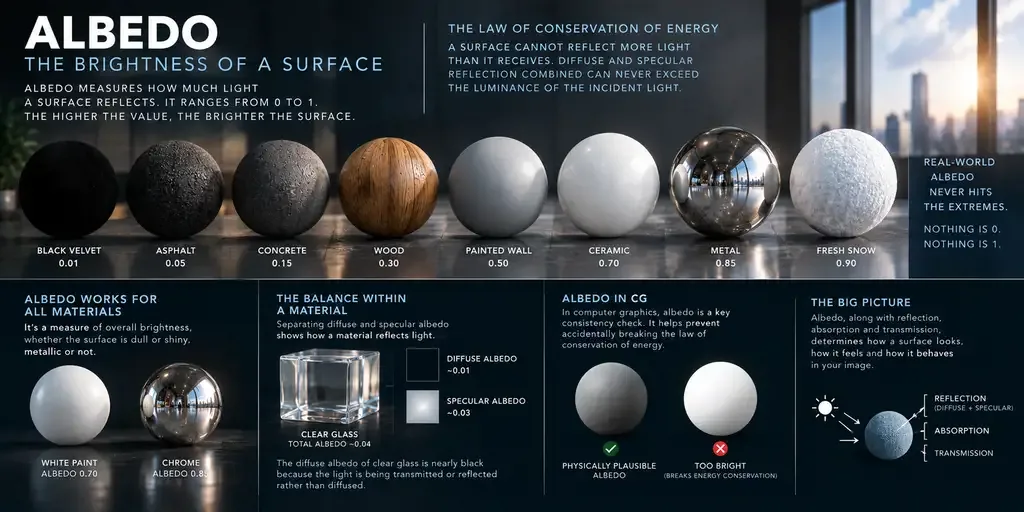
By the law of conservation of energy, a surface cannot reflect more light than it receives. Diffuse and specular reflection combined can never exceed the luminance of the incident light.
Albedo measures a surface's reflective luminosity from 0 to 1. Zero reflects nothing, one reflects everything. Nothing real sits at either end - no material is 100% absorbent, and even the whitest or shiniest material absorbs something. Black velvet is as low as 0.01; fresh snow reaches 0.9.
Because real-world albedo includes both diffuse and specular reflection, it is a good measure of a material's overall brightness whether it is dull or shiny, metallic or not. It matters most in CG, where conservation of energy is easy to break by accident, so albedo works as a consistency check. Separating diffuse and specular albedo shows the balance within a material - the diffuse albedo of clear glass is nearly black despite almost no absorption, because the light is being transmitted or reflected rather than diffused.
The case study worth reading twice
Dinur presents a CG interior render beside the photograph that was used as its reference. His account is honest and useful: he initially assumed the photo was an improved version of the render, which says a great deal about the quality of the work. But he also admits he preferred the photograph - and that preference, with nothing he can point at to justify it, is the whole problem of photorealism in one example.
Terms from this chapter
- Volume - anything light can hit: solid, liquid or gas.
- Absorption - photon energy converted to heat. Defines color by negation.
- Specular reflection - orderly reflection at a predictable angle. Preserves the image.
- Diffuse reflection - random scatter. Destroys the image, produces surface color.
- Surface normal - the line describing which way a surface faces.
- Highlight - the dominance of a bright light source within a soft specular reflection.
- Rim highlight - bright specular along a bevel or contour, each curve acting as a mini fish-eye.
- Grain - the microscopic crystals or fibres that make a surface scatter.
- Subsurface scattering - light penetrating below the surface and exiting elsewhere. Part of diffuse behavior in nearly all dielectrics.
- Dielectric - non-metallic.
- Translucent - transmitting and scattering at the same time.
- Refractive index (IOR) - ratio of light speed in vacuum to light speed in the material.
- Albedo - total reflective luminosity, 0 to 1.
Check yourself
- Name the three possible outcomes when a photon meets a volume.
- Why is a red wall red? Answer using absorption.
- What is the actual difference between specular and diffuse reflection, and why does Dinur say the boundary is not real?
- Why does a chrome sphere show a highlight more readily than a chrome cube?
- What produces a rim highlight, and what does it tell the viewer?
- Why is subsurface scattering not just a property of skin and wax?
- Two walls, same projector. What single property most determines which gives you a brighter image?