
Where Part 2 starts
Course image created with generative AI using OpenAI tools, with direction and curation by the course instructor.
Part 1 was about what photorealism is. Part 2 is about how light actually behaves, on the argument that you cannot fake something convincingly until you understand it. Dinur writes it for artists rather than physicists - the goal is a working mental model, not equations.
Much of this chapter overlaps with the Light and Surface pages you already have. Read it as the same material approached from a different angle, with some additions worth having.
Waves or particles
Course image created with generative AI using OpenAI tools, with direction and curation by the course instructor.
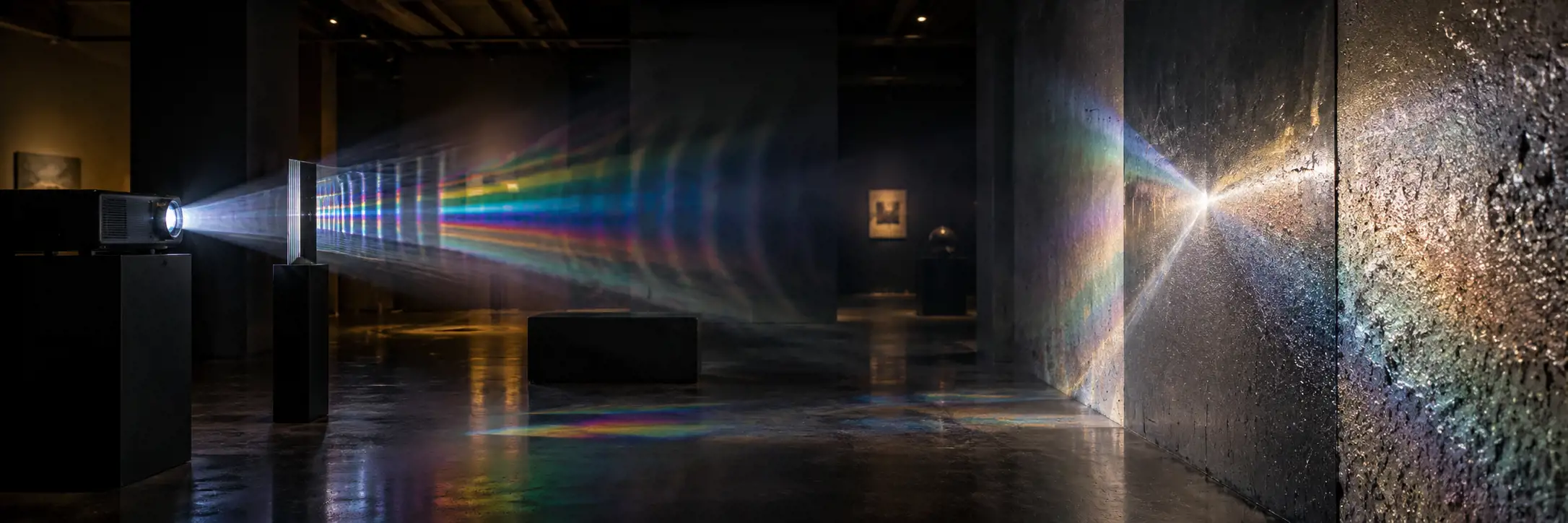
Light travels in a straight line and reflects at a predictable angle, which is particle behavior. It also produces diffraction and interference patterns, which is wave behavior. The argument ran from Huygens against Newton in the 17th century through to quantum physics, which settled it: light is both.
Dinur's practical point is that the duality is a tool, not a puzzle. Some phenomena are easier to think about one way than the other. Color makes more sense as waves. The difference between specular and diffuse reflection makes more sense as particles. Rendering techniques split the same way - thin film diffraction is calculated as waves, photon mapping treats light as particles. Use whichever view makes the problem in front of you clearer.
Light as waves: the spectrum
Course image created with generative AI using OpenAI tools, with direction and curation by the course instructor.
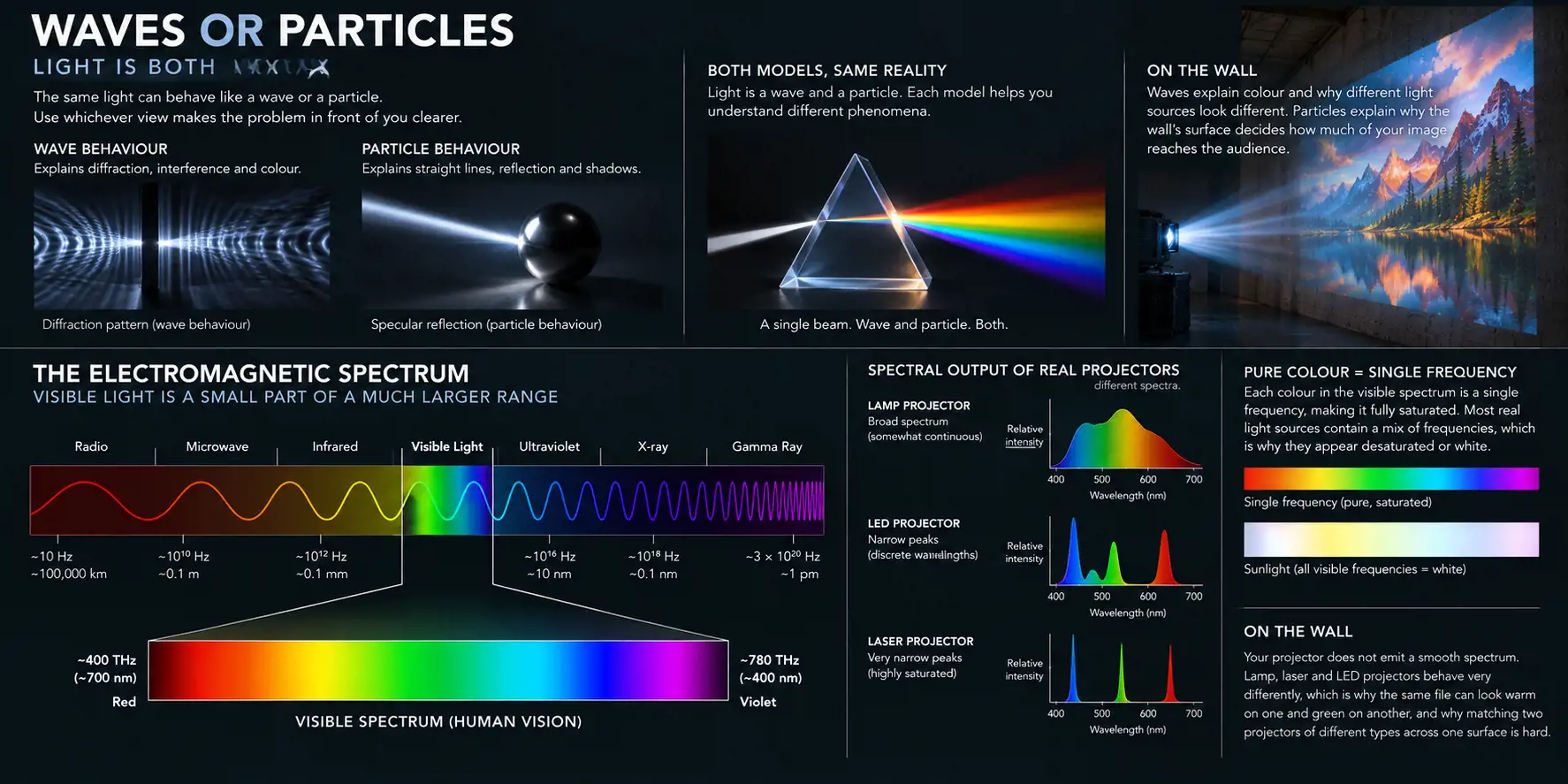
Visible light is a narrow slice of the electromagnetic spectrum. Waves are defined by frequency in hertz and wavelength in meters. At the bottom sit radio waves around 10 Hz with wavelengths up to 100,000 kilometers; at the top, gamma rays around 300 exahertz with wavelengths down to a picometer. In between, from long to short: radio, microwave, infrared, visible light, ultraviolet, X-ray.
Visible light runs from red at about 400 terahertz to violet at about 780 terahertz. There is nothing physically special about that band. It is simply the part humans detect, and the range is not consistent across living things - some snakes sense infrared, many insects and birds see ultraviolet.
One detail worth carrying forward: the colors along the visible spectrum are pure, fully saturated, because each is a single frequency. Most real light sources radiate a mix of frequencies, so most of the light you actually see is somewhat desaturated. Unfiltered sunlight contains nearly all visible frequencies, which is why it is white - fully desaturated.
Light as particles: photons
Course image created with generative AI using OpenAI tools, with direction and curation by the course instructor.
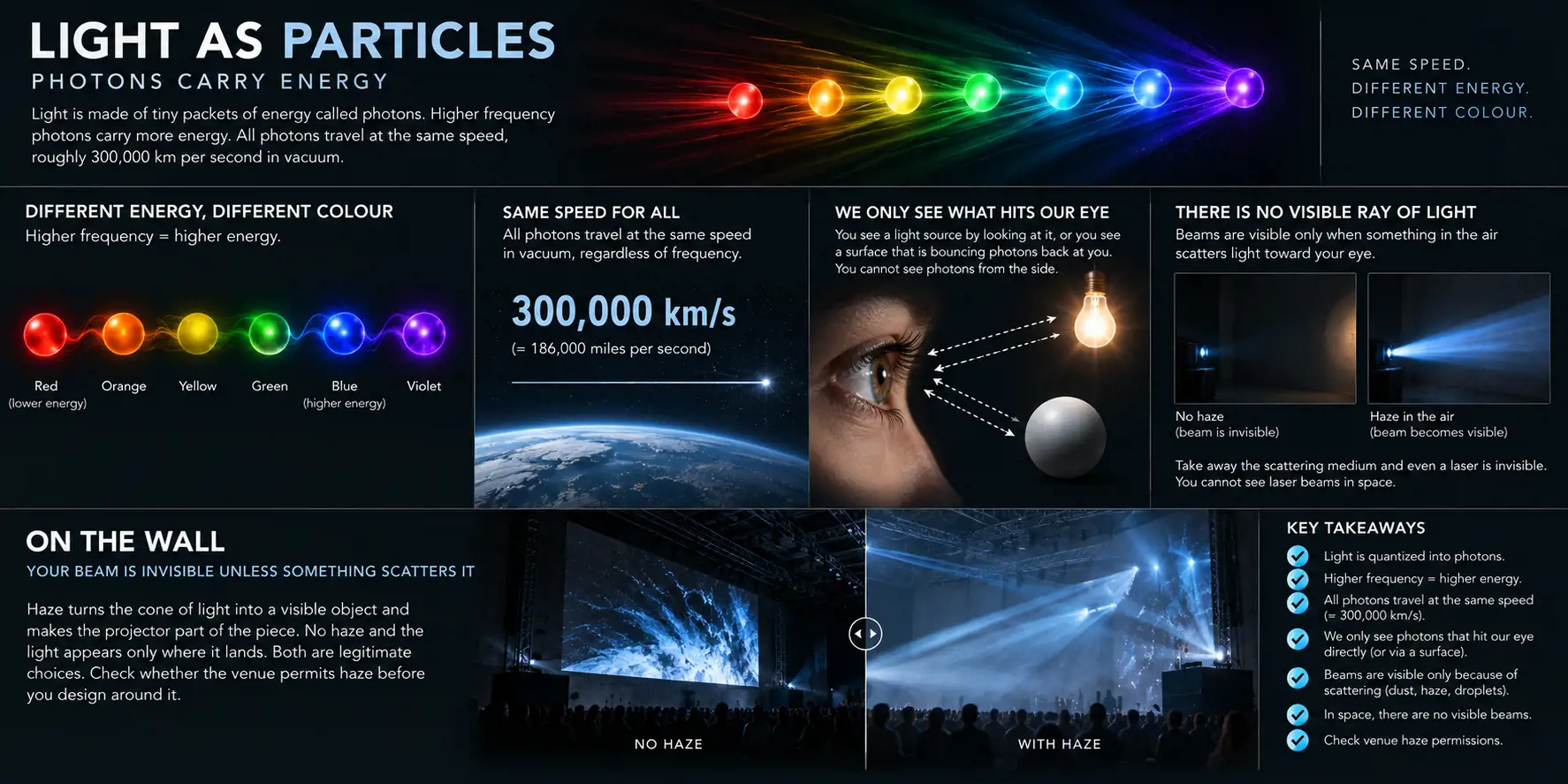
Energy is quantized into packets called photons. The higher the frequency, the higher the energy - a blue photon carries more than a red one. All photons travel at the same speed regardless of frequency, roughly 300,000 km per second in vacuum.
The consequence that matters: we only see photons that hit the retina directly. You see a light source by looking at it, or you see a surface that is bouncing photons back at you. You cannot observe photons from the side, the way you watch traffic pass on a highway.
So there is no such thing as a visible "ray of light". The shafts on a concert stage, the beams coming through a gap in the blinds - those are visible only because dust and water droplets are scattering light toward your eye. Take away the scattering medium and even a laser is invisible. Despite what films tell you, you cannot see laser beams in space.
Light decay and the inverse-square law
Course image created with generative AI using OpenAI tools, with direction and curation by the course instructor.
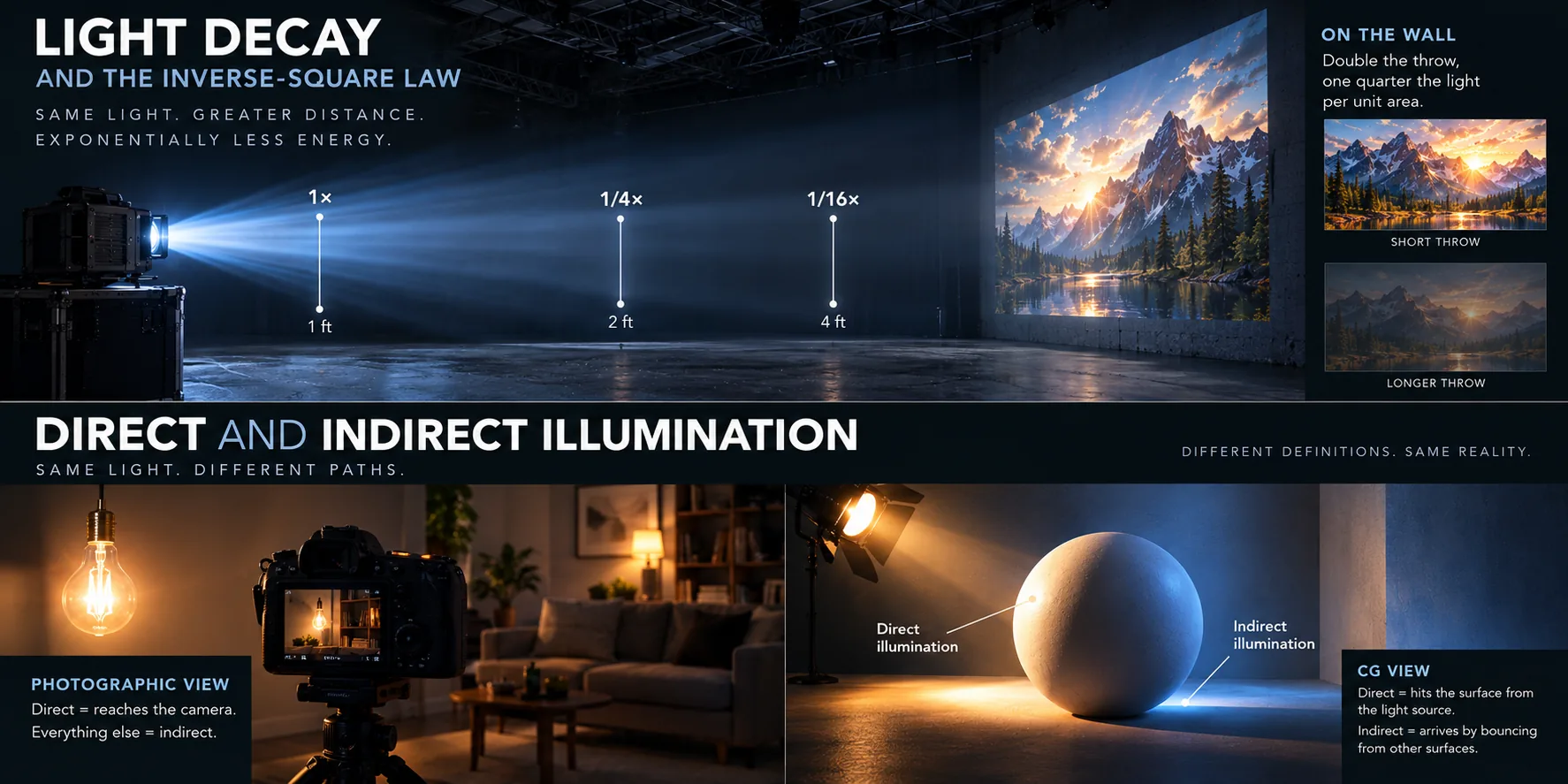
Intensity falls off at a quadratic rate: light intensity is inversely proportional to the square of the distance from the source. If intensity is 1 at one foot, it is a quarter at two feet and a sixteenth at four feet.
The mechanism is worth being precise about, because it is commonly misunderstood. The photons do not lose energy and do not slow down - that is why we can see stars hundreds of light years away. What changes is density. A source emits a fixed number of photons per moment. Near the emitter they are tightly bunched; as they travel outward in all directions the gaps between them grow. Further away, fewer photons are likely to hit any given object.
Two examples that make it stick: you see a distant star because looking directly at it means looking where the photons are densest. A traffic light is too weak to illuminate the pavement a few feet below it, yet is clearly visible from hundreds of feet away, for the same reason.
The practical consequence is a large spike in luminance near any light source. Put a light meter around a living room lit only by lamps and the readings jump sharply as you approach a bulb. In daytime they jump even higher near a window - and a window is not a light source, just an opening onto a much brighter environment. This spike is why light sources dominate specular reflections so completely.
Direct and indirect illumination
Careful here, because the term means two different things depending on who is using it.
In photographic terms the distinction is about the camera. Point a camera at a bulb and the photons from the filament reach the sensor on a direct path - that is direct illumination. Everything else in the frame arrived after bouncing off at least one surface, so it is indirect. By that definition most of what any camera records is indirect light.
In CG jargon the distinction is about the receiving surface, not the camera. A surface lit straight from a light source receives direct light; a surface lit by bounce from its neighbors receives indirect light. That version makes more sense for rendering, because direct light comes from a small defined area and is much faster and less noisy to calculate than indirect.
Dinur adds that even this separation is somewhat artificial. A camera pointed at the sun is not recording purely direct light either - by the time sunlight arrives it has been scattered, absorbed and refracted by miles of air, water droplets and dust. The categories help you analyze a photograph. They do not describe reality neatly.
"Ambient light" does not exist
Course image created with generative AI using OpenAI tools, with direction and curation by the course instructor.
This section is the most useful in the chapter, and the most likely to change how you talk.
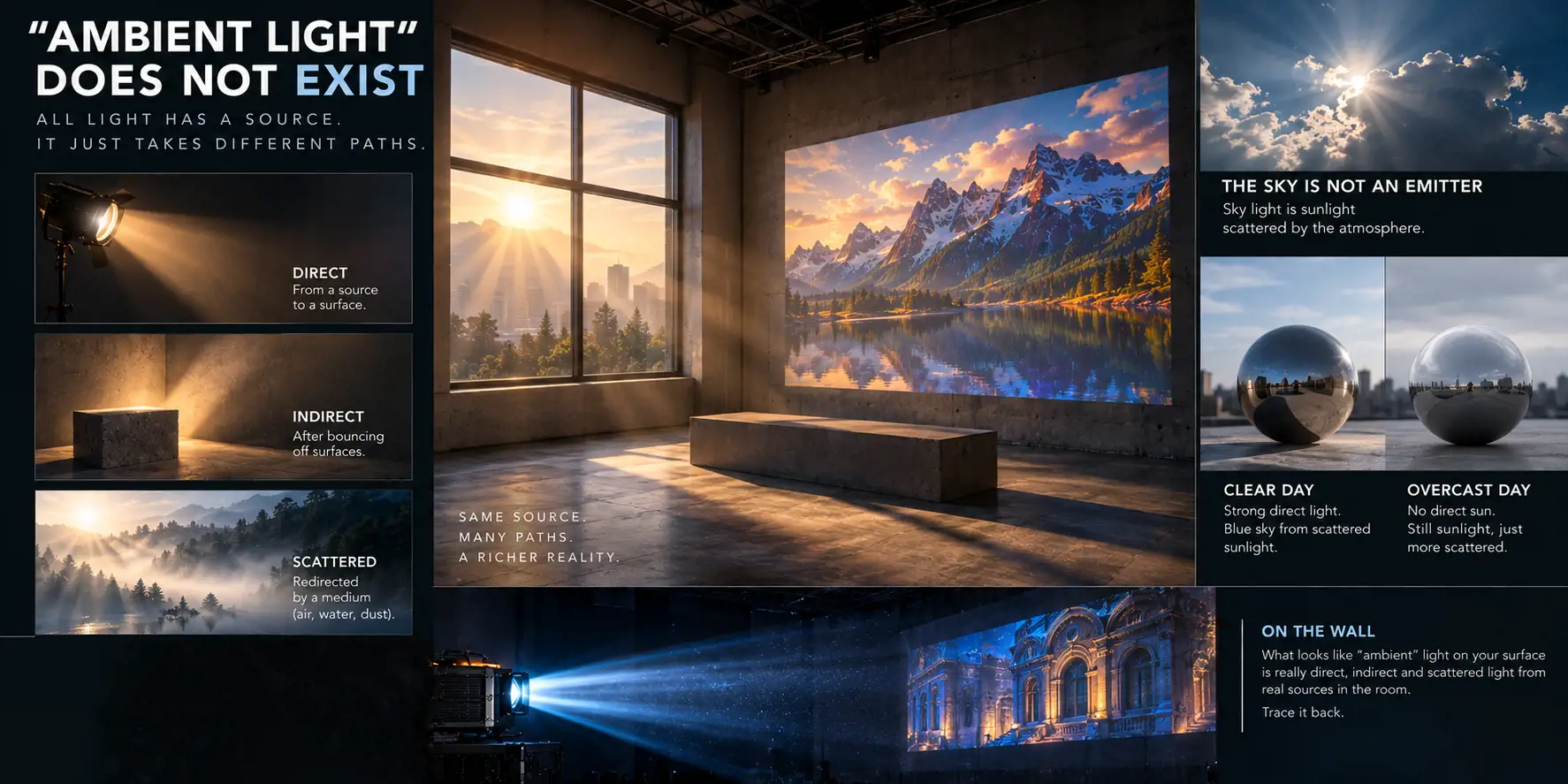
The term carries at least three meanings. Photographers use it for the available light already in a scene, as opposed to lighting they add. Interior designers use it for the general lighting layer, as against task or accent lighting. In visual art and digital art it means the soft, uniform, complementary light that does not appear to come from any particular direction and casts no distinct shadow.
That third usage is the misleading one, because it implies a separate non-directional emitter exists. There is no such thing. Every photon travels from one point to another, so all light is directional. Illumination starts as directional light from a distinct source, and becomes multi-directional only after it bounces off surfaces or scatters through a volume.
The standard CG shortcut is to pair a directional "sunlight" with a spherical "sky light" to fake daylight. It works, but it does not represent reality: the sky is not an emitter. The soft light coming from it originates entirely with the sun and is tightly coupled to it. Even the diffuse light in a room lit by a window on an overcast day is all sunlight, arriving by a longer route.
Dinur's recommendation: say diffused light or scattered light, and when lighting a scene, stop treating any part of the light as ambient. Trace it back to a source and the interaction events that softened it. This matters more now that renderers genuinely simulate global illumination.
Terms from this chapter
- Wave-particle duality - light behaves as both; use whichever model makes the problem clearer.
- Photon - a quantised packet of light energy. Higher frequency means higher energy.
- Inverse-square law - intensity falls with the square of distance, because photon density drops, not because photons weaken.
- Direct illumination - light reaching the sensor straight from a source (photographic), or a surface lit straight by a source (CG).
- Indirect illumination - bounced light.
- Diffused / scattered light - the accurate replacements for "ambient light".
Check yourself
- Which is easier to explain with waves, and which with particles: color, or the difference between a mirror and a matte wall?
- Why is sunlight white, when a single frequency of light is fully saturated?
- Why can you not see a laser beam in a clean room?
- Light at four feet is what fraction of light at one foot, and why?
- Give the photographic definition of direct illumination and the CG definition. What is the difference?
- Why does Dinur say ambient light does not exist, and what should you say instead?