
The premise
The physics of light and matter do not change between industries. What changes is what each industry is willing to trade for realism, and what it is not. Dinur walks through three: visual effects, games, and visualization.
Read this chapter as a set of case studies in constraint. Every field has decided which compromises are acceptable, and those decisions show up on screen.
Visual effects

Course image created with generative AI using OpenAI tools, with direction and curation by the course instructor.
VFX work gets cut in among live-action shots, so it has to match footage that is already there. That single fact drives everything else.
Plausibility beats beauty. A pretty sky may have to be overexposed and ugly to sit correctly with the plate. A beautifully detailed matte painting may end up completely out of focus because the camera is focused on the foreground. Those compromises are more common in VFX than anywhere else, and artists make them without argument.
The camera is known. VFX happens in post, after the film is shot and roughly cut. The angles, moves and framings already exist, so the team can spend resources only on what the lens will see. That is a real advantage - and it is why matte paintings are almost never built outside the context of a specific shot.
It is not real-time. Offline rendering allows complexity and quality that a game engine cannot reach. The cost is render time and large teams.
Budget is not the deciding factor. Dinur is explicit that stunning VFX shows up across the whole budget range. What decides the outcome is the artists' understanding of light and color and their eye for detail. He says the material in the book should serve a student project as well as a tentpole.
The example he uses is worth remembering: in The Greatest Showman, the VFX included changing the season, fixing a road, and adding a ceiling. Nothing spectacular, and every one of them demanded a completely photoreal approach because nobody is supposed to notice.
Games
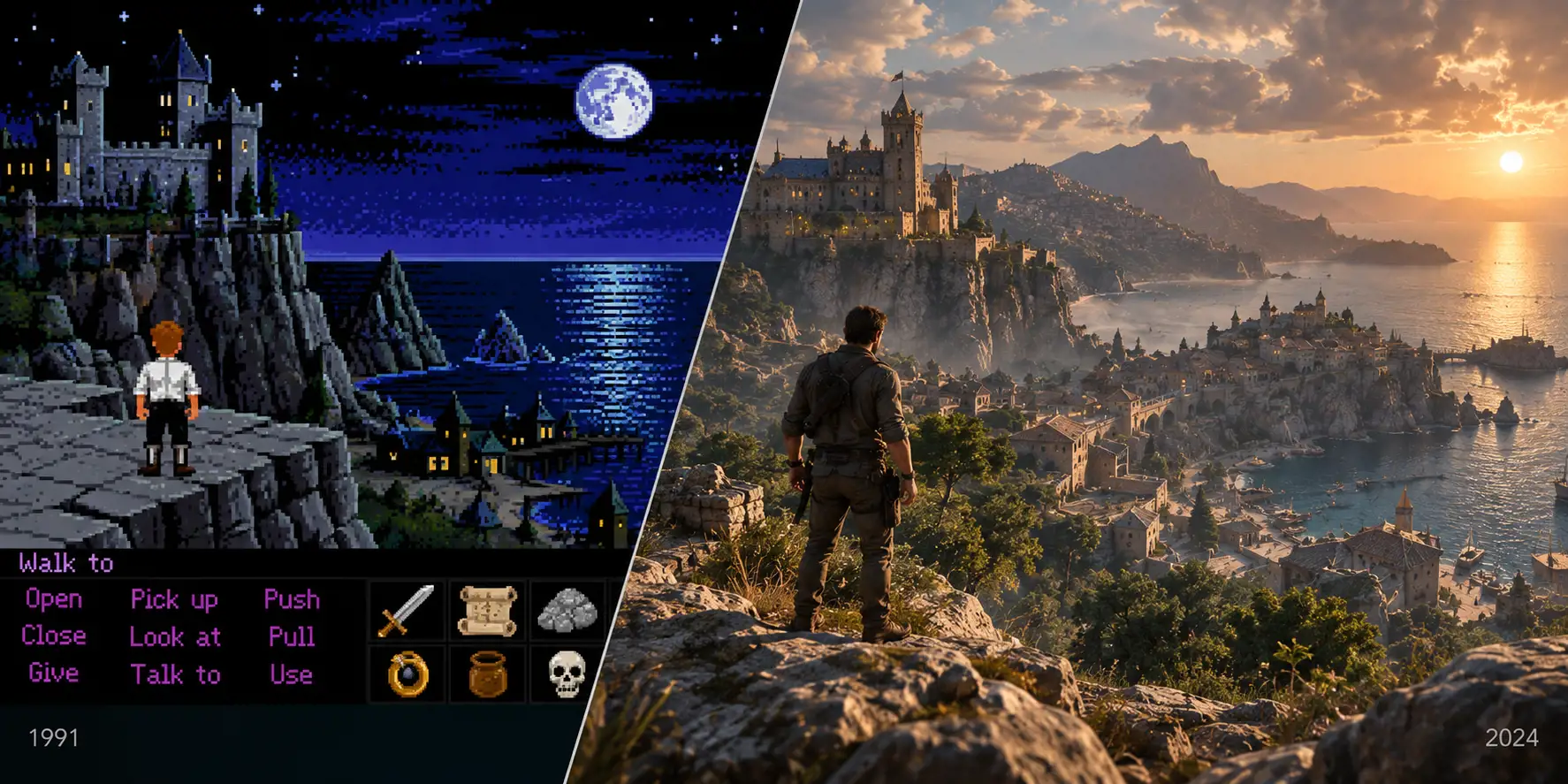
Course image created with generative AI using OpenAI tools, with direction and curation by the course instructor.
No field has moved further. Compare a 1991 adventure game to a modern equivalent and the gap is enormous - four decades of hardware and software have completely rebuilt what a game looks like.
Photorealism is not a requirement in games, and plenty of successful titles are proudly stylized. But for the ones chasing realism, the obstacles are specific:
- The camera belongs to the player. A playable environment has to hold up from every angle. The 2D and 2.5D projection tricks that VFX leans on can only be used outside the playable area - distant backgrounds, skies.
- Everything must run in real time. Constant attention to polygon count, texture size, a robust LOD system, and the rules of the engine.
- Open worlds must be large and detailed at once. Quality has to hold across the whole extent, not just where the director pointed the camera.
He notes the gap is closing from both directions: game engines now offer depth of field, realistic flares and color grading, while film production has adopted game technology on set. And the reason games have no integration problem is simply that they are rarely combined with live-action footage - which buys stylistic freedom at the cost of having no plate to match to.
Visualization
The broadest of the three, and the one where photorealism is sometimes actively unhelpful. A scientist studying protein structure wants clear graphical representation, not convincing lighting. A forensic visualization needs precise events and timing.
But where the goal is to present a subject as faithfully as possible, photorealism becomes essential. That is architectural and product visualization.
Architectural visualization
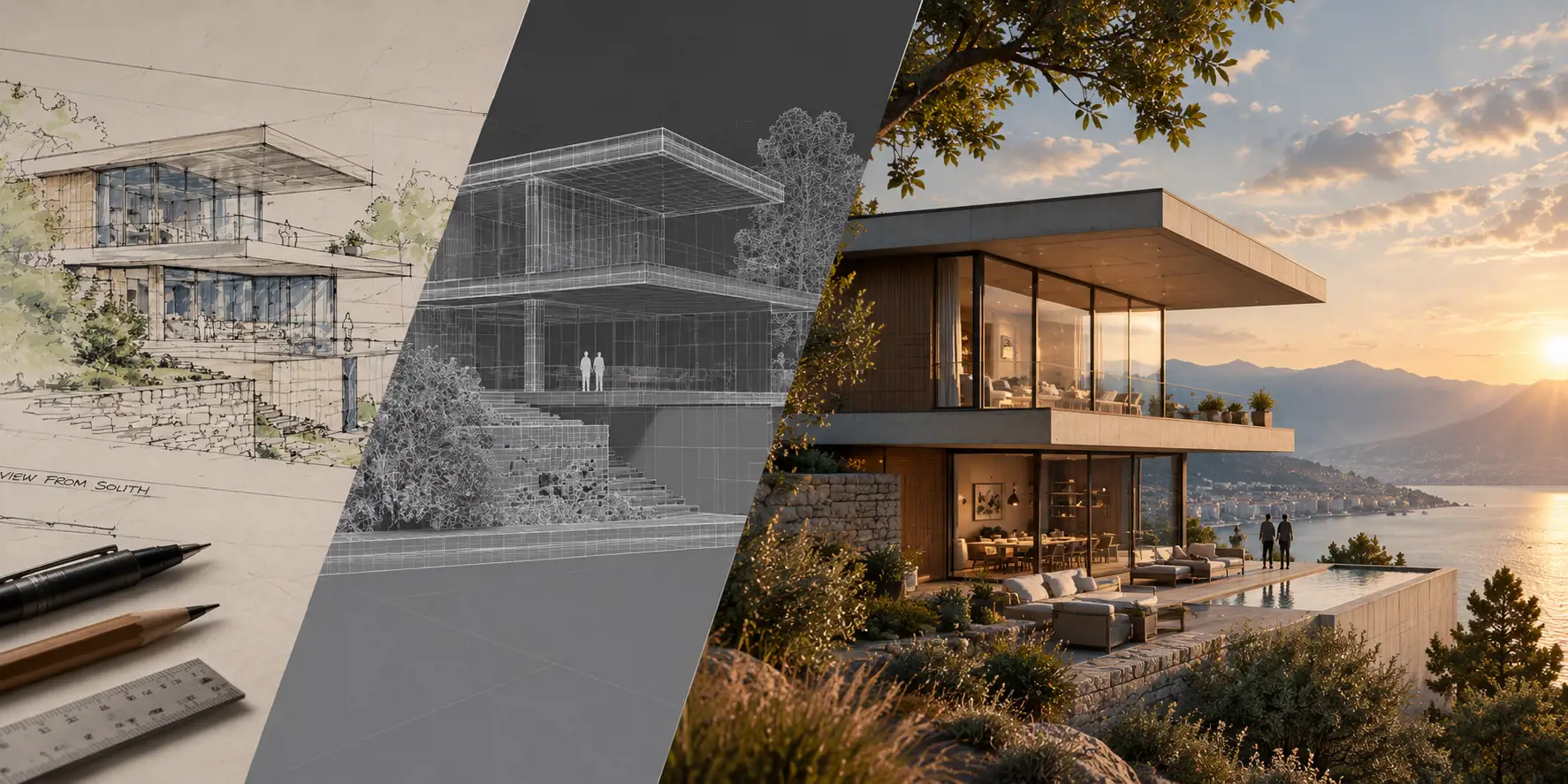
Course image created with generative AI using OpenAI tools, with direction and curation by the course instructor.
The craft predates computers by a long way - architectural illustration goes back to ancient Greece and peaked in sophistication in the 20th century. Unlike working drawings, illustrations were always about conveying the aesthetic impact rather than the technical detail.
CG changed it completely, because a 3D model can be viewed and rendered from any position, walked through, flown over, relit for a different time of day, or retextured for a quick design comparison.
Dinur points out a tension unique to ArchViz: the image is not the final product. In VFX and games, the image is the goal. In ArchViz the image predicts a building that does not exist yet. Developers and clients want photoreal renders because they want an accurate preview. Architects often prefer something more abstract - because what happens if the finished building fails to match the picture? Photorealism can be a liability.
He also documents an aesthetic split that is genuinely useful to know about. VFX and games add dirt, grime and imperfection to escape the synthetic look. ArchViz emphasizes a clean, fresh surface, because that is what the client is buying. To compensate for the missing grime, ArchViz artists load the frame with auxiliary detail instead - furniture, upholstery, carpets, curtains, plants. Two opposite routes to the same richness.
Other ArchViz conventions that trade realism deliberately: images often keep everything sharp front to back, disregarding depth of field, so the whole structure reads clearly. Generic 2D cutout people get dropped into meticulously rendered environments with lighting and sometimes perspective that plainly do not match. In a film that would be unacceptable. In the language of architecture the figures read as embellishment rather than as co-equal elements, so the mismatch does not hurt the pitch.
Product visualization

Course image created with generative AI using OpenAI tools, with direction and curation by the course instructor.
Roughly 75% of the IKEA catalogue is CG. Not because the furniture does not exist, but because arranging, lighting and photographing product sets costs more than building them virtually - and once virtual, changing colors, textures, lighting or camera is nearly free.
The trade-off is that the success is entirely dependent on photorealism. The product must look exactly as it does in life, and the smallest crack in believability breaks it.
Scale changes the problems. Products are small and there are fewer objects, so there is less need for the auxiliary detail ArchViz relies on. But close-up presentation demands accuracy, which pushes the difficulty into texturing and shading. Lighting matters enormously on a single small object, and the techniques usually imitate studio photography.
The case study: exterior architectural renders
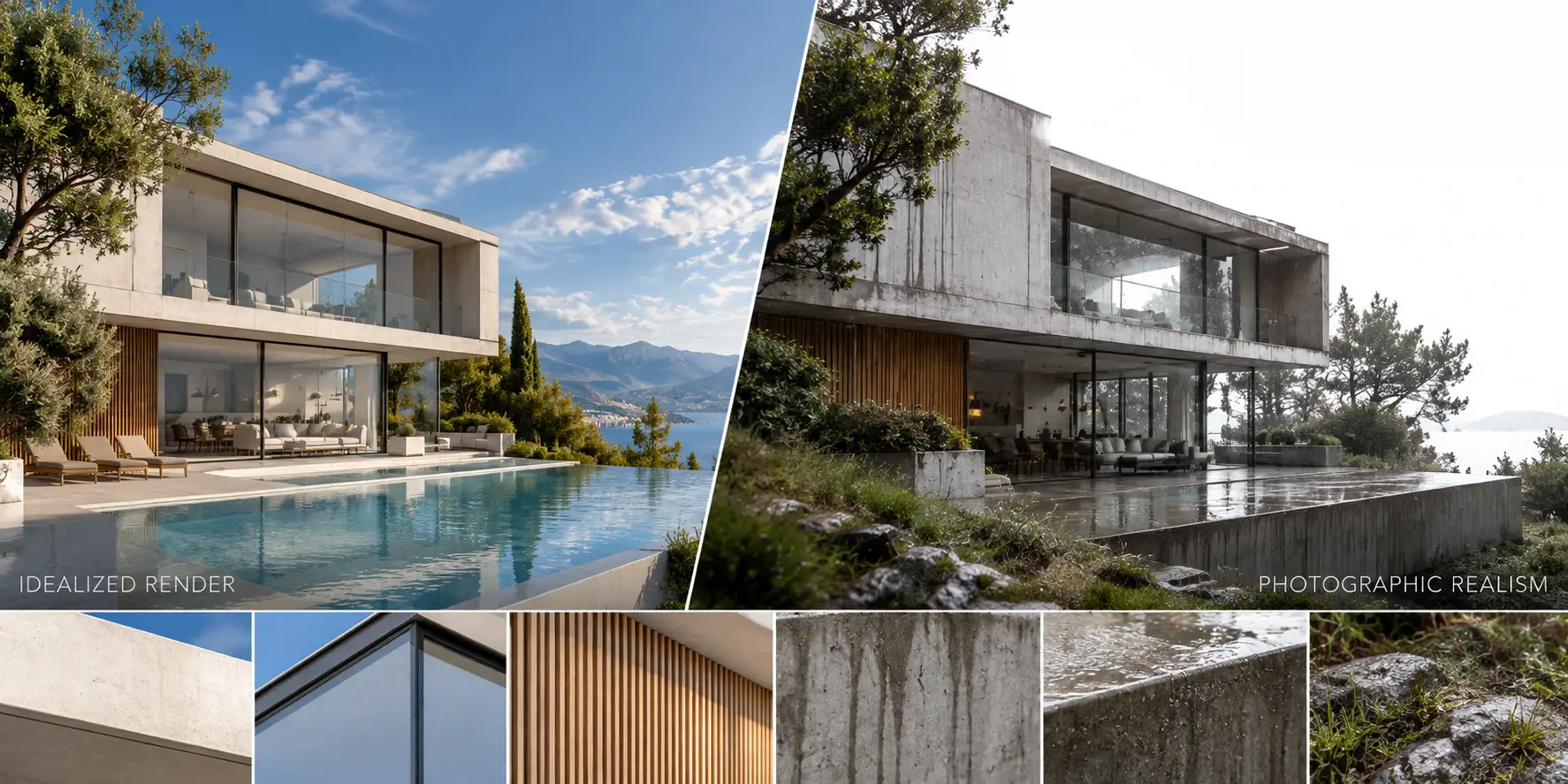
Course image created with generative AI using OpenAI tools, with direction and curation by the course instructor.
Dinur says he found it much harder to source believable exterior renders than interior ones, and the reasons are instructive:
- Interiors are mostly man-made objects. Their realism does not depend on detailed natural environments, which are harder to generate.
- In real photography the sky is often blown out because the photographer exposed for the building. ArchViz artists and clients tend to preserve sky detail instead, which looks better and reads less photographic.
- Blown-out white walls get toned down to keep architectural detail legible.
- The habit of keeping surfaces clean hurts most outdoors, where dirt, grime and wear are naturally prominent.
The render he holds up as successful does the opposite on each count: it accepts a bright, plain white sky, lets reflections and bright areas overexpose slightly rather than defending every highlight, and includes real wear - water flow marks down an outer wall - while still reading modern and sleek.
Terms from this chapter
- Offline rendering - non-real-time rendering, where quality is limited by time and budget rather than frame rate.
- Plate - the live-action footage a visual effect has to sit inside and match.
- ArchViz - architectural visualization.
- Auxiliary detail - the props, plants and furnishings added to give a clean scene richness.
Check yourself
- Why does VFX accept an ugly sky where ArchViz would not?
- What can a VFX team do that a game team cannot, and why?
- Why might an architect prefer a less photoreal render than the developer paying for it?
- Why does ArchViz add furniture where VFX adds dirt?
- Which of the three industries is your projection piece most like, and which constraint from the other two still applies to you?